What Is Pass-Through Charging on a Power Bank?
April 02, 2026
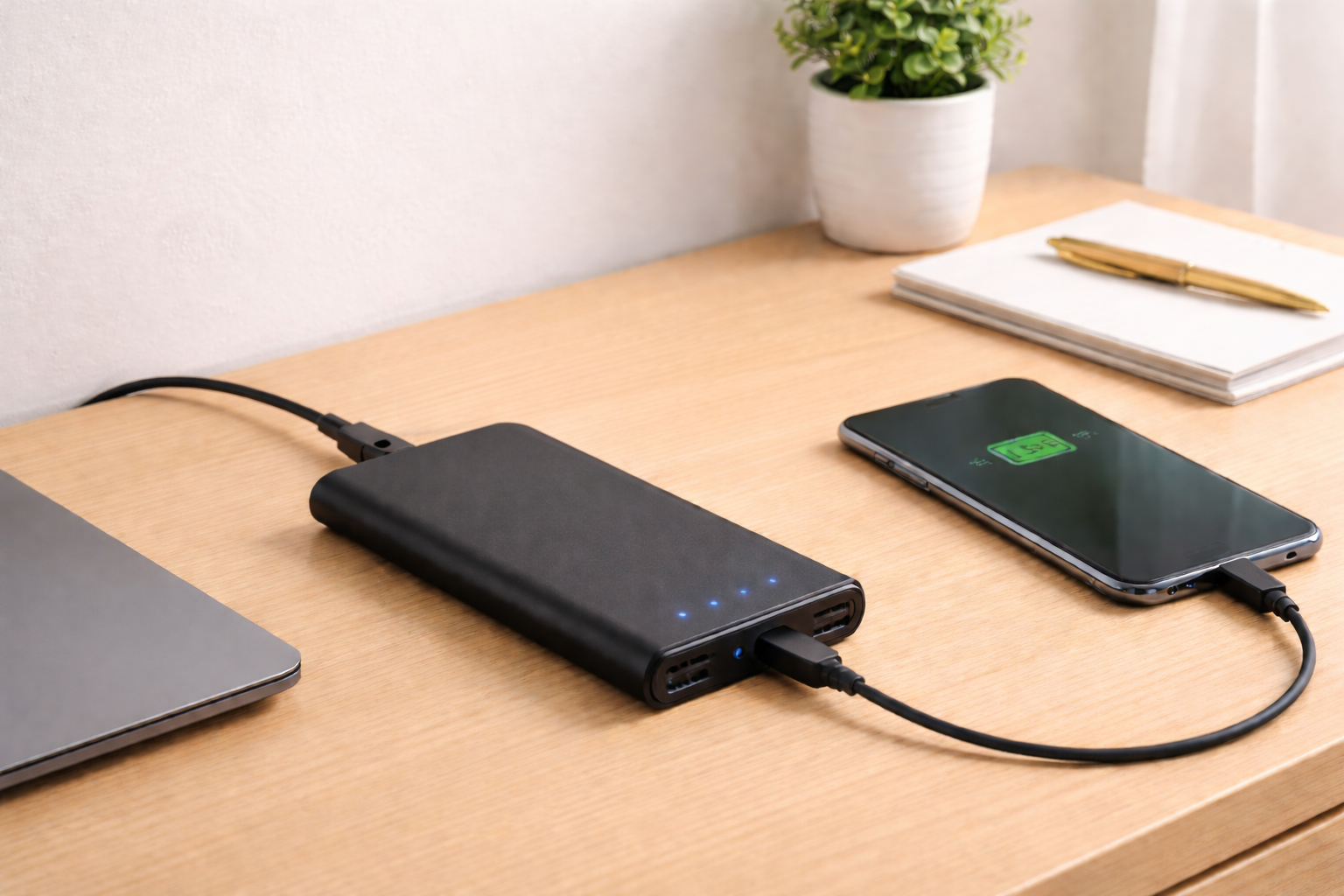
Pass-through charging is a feature that lets a power bank charge itself from a wall outlet while simultaneously charging connected devices. Instead of needing two outlets—one for the power bank and one for your phone—you plug the power bank into the wall and your device into the power bank. Both charge at the same time. Not all power banks support this feature, and those that do handle it in meaningfully different ways.
Quick Answer
- Pass-through charging = power bank charges itself and your devices from a single wall outlet
- It works via internal circuitry that prioritizes wall power to connected devices first, then tops up the power bank
- Heat generation is the main trade-off; lower-quality implementations shorten battery lifespan
- It is a premium feature—budget power banks often disable output when receiving input
How Pass-Through Charging Works
When a power bank is connected to a wall outlet, incoming current flows through an integrated circuit (IC) controller before reaching the battery. In a pass-through-capable device, this controller splits that flow: some power goes to connected devices, the remainder charges the power bank’s own cells.
The key mechanic is prioritization. The IC evaluates how much power is available from the wall adapter and how much each connected device needs. Wall power goes to the devices first; whatever remains flows into the power bank’s battery. This is why charging the power bank itself becomes slower when devices are connected—less current is available for the battery.
Direct Pass-Through vs. Charge-Discharge Pass-Through
There are two circuit architectures used in practice:
| Type | How It Works | Efficiency | Battery Impact |
|---|---|---|---|
| Direct pass-through | Wall current routes directly to device, bypassing the battery | Higher | Lower wear |
| Charge-discharge pass-through | Power bank charges first, then discharges to device | Lower | More heat, more wear |
Direct pass-through is the better implementation. The battery cells are not involved in the power delivery to your phone—current flows from the wall, through the power bank’s circuitry, and out to the device. The battery only receives what’s left.
Charge-discharge pass-through is the cheaper approach: current enters the battery and exits the battery simultaneously, forcing the cells to do two jobs at once. This generates significantly more heat and accelerates cell degradation.
The Role of the BMS
Every power bank with pass-through charging includes a Battery Management System (BMS)—onboard circuitry that monitors temperature, current flow, and cell voltage. During pass-through, the BMS works harder than during normal charging because it must regulate two simultaneous power flows. In high-quality power banks, the BMS manages this without stress. In low-quality implementations, the BMS is either undersized or absent, which is why cheap power banks can overheat when attempting pass-through.
Why Not All Power Banks Support It
Pass-through charging requires additional circuitry—specifically dual-circuit pathways and a more capable IC controller. This adds to the bill of materials. Budget manufacturers omit or disable this feature to cut costs and avoid the thermal management challenges that come with it.
A common behavior in budget power banks: when you plug them into a wall charger, any connected output devices stop receiving power. The device detects an incoming charge and shuts off output entirely. This is a deliberate design choice, not a malfunction.
Signs that a power bank supports pass-through:
- Explicitly listed in specifications as “pass-through charging” or “UPS mode”
- The output ports remain active while the input is connected
- The indicator lights show both charging-in and charging-out simultaneously
Efficiency and Battery Lifespan Trade-Offs
Pass-through charging is less efficient than charging devices directly from a wall outlet. Energy conversion losses occur twice: once when converting AC from the wall to DC for the power bank, and again when that DC is regulated and delivered to the connected device. In practice, expect 15–25% more total energy consumption compared to direct wall charging.
The bigger long-term trade-off is battery lifespan. Lithium-ion cells are rated for a finite number of charge cycles—typically 300–500 full cycles for standard cells, up to 1,000+ for higher-quality cells. Pass-through charging, depending on implementation, can count as partial cycle use even when the power bank is mostly full. Over months of daily use, this adds up.
Practical guidance:
- Use pass-through when outlets are scarce (airports, hotels, shared workspaces)
- Avoid using it as the default charging method for both devices simultaneously
- Prefer power banks that specify direct pass-through over charge-discharge pass-through
- Ensure the wall adapter meets or exceeds the power bank’s rated input wattage; an underpowered adapter reduces pass-through effectiveness
Pass-Through on USB-C Hubs and Docking Stations
Pass-through charging also appears on USB-C hubs and docking stations, but the implementation differs. A USB-C hub with pass-through uses USB Power Delivery (USB PD) to negotiate power between the wall adapter and the connected laptop or tablet. The hub itself consumes a small amount of power for its own operation (typically 5–10W) and passes the remainder to the device.
For this to work correctly, both the wall adapter and the receiving device must support USB PD. If the wall adapter doesn’t support PD, the hub may function (data ports work) but won’t charge the connected device at full speed or at all.
This is distinct from power bank pass-through, where the device being charged doesn’t need to support any specific protocol—it just receives power from the power bank’s output port.
Common Mistakes
Assuming all power banks support it. Manufacturers sometimes list “simultaneous charging” as a feature without distinguishing between true pass-through and simply having multiple output ports. Multiple output ports means charging multiple devices from the battery—not pass-through from a wall source.
Using an underpowered wall adapter. If the wall adapter delivers less wattage than the power bank’s rated input, the power bank may still operate in pass-through mode but will charge itself slowly or not at all while devices are connected. Check the power bank’s input spec (e.g., 18W, 45W, 65W) and match the adapter accordingly.
Expecting full fast charging speeds. If your phone supports 30W fast charging but the power bank only outputs 18W, the phone won’t charge at 30W during pass-through. Pass-through doesn’t upgrade the power bank’s output capabilities—it only determines whether the output ports stay active while the input is connected.
Frequently Asked Questions
Does pass-through charging damage the power bank?
It depends on the implementation. Direct pass-through causes minimal extra wear. Charge-discharge pass-through generates more heat and additional cycle use on the cells. Both types accelerate degradation compared to not using pass-through at all, which is why it is better suited for occasional use than as a daily default.
Is pass-through charging safe?
Yes, in power banks with a functioning BMS and proper thermal management. The concern is heat—if a power bank gets notably warm during pass-through, that is a sign of inadequate heat dissipation. Reputable manufacturers build in thermal cutoffs that shut down the device before temperatures reach dangerous levels.
Will pass-through slow down charging for my connected device?
It can. If the wall adapter’s total output is split between the device and the power bank’s battery, your device may charge slower than it would from a direct wall connection. The extent depends on how much power the wall adapter delivers and how aggressively the power bank’s IC prioritizes device charging.
How do I know if my power bank supports pass-through?
Check the specification sheet on the manufacturer’s website. Look for explicit mention of “pass-through charging,” “UPS mode,” or “simultaneous charge in/charge out.” If it is not listed, test it: plug the power bank into a wall charger, then connect a device—if the device starts charging, pass-through is supported.
Does pass-through work wirelessly?
Some power banks support wireless pass-through, where the Qi charging pad remains active while the power bank charges from a wall source. This is rarer and requires the same underlying direct pass-through architecture to avoid excessive heat at the wireless charging coil.
Summary
Pass-through charging lets a single wall outlet charge both a power bank and a connected device at the same time. It works through prioritization circuitry that routes wall power to connected devices first. The quality of the implementation—direct pass-through versus charge-discharge pass-through—determines how much heat is generated and how quickly the battery degrades. It is a premium feature absent from many budget power banks and is best used when outlets are limited rather than as a daily charging method.
Need help choosing?
Take the quiz