What Does mAh Mean? Capacity Explained
February 17, 2026
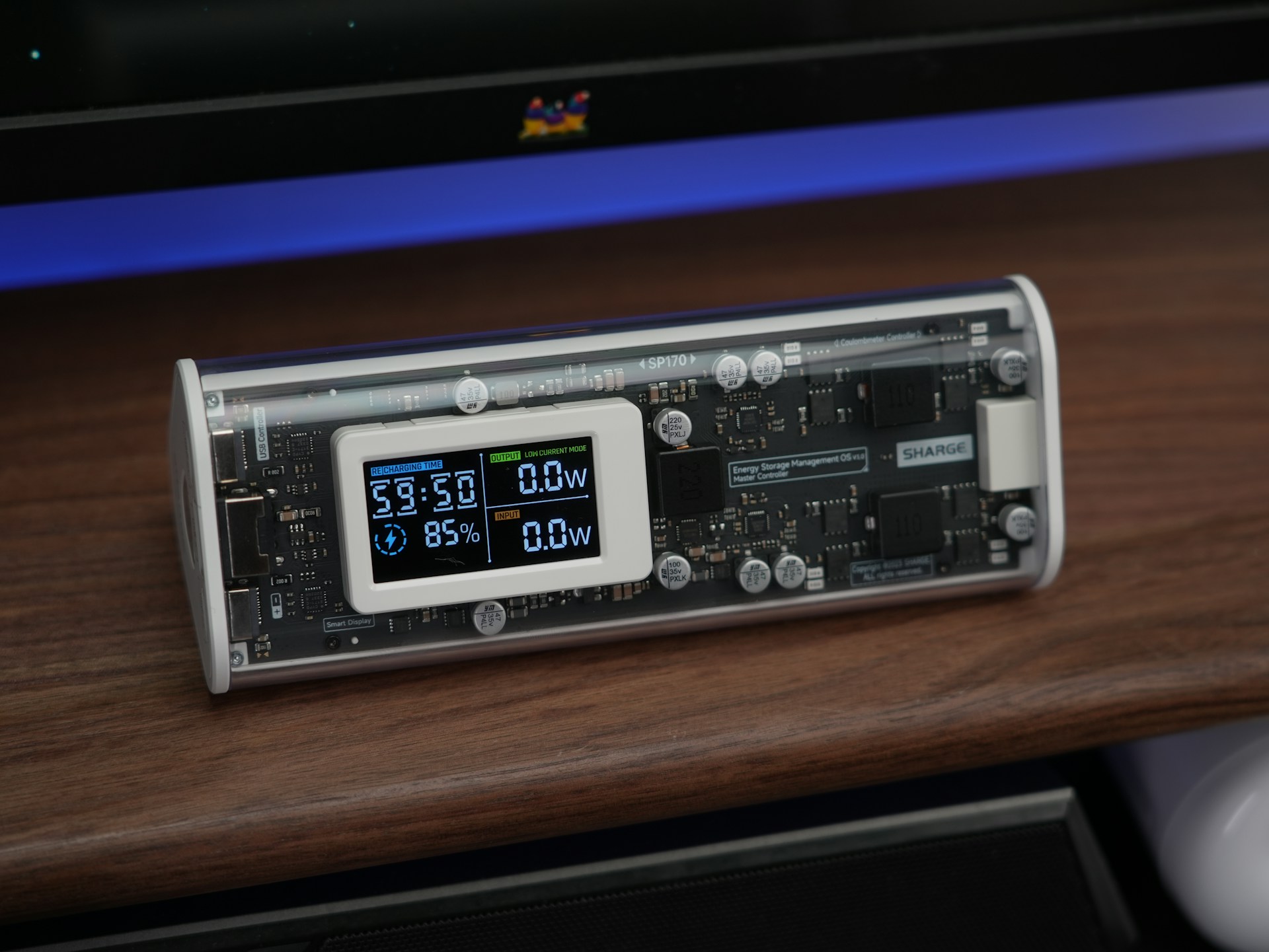
mAh stands for milliampere-hour — a unit that measures how much electrical charge a battery can store. A 10,000mAh power bank holds 10,000 milliampere-hours of energy, which translates to roughly 2–2.5 full charges for a typical smartphone. The higher the mAh number, the more energy the power bank stores, and the more times it can recharge your devices before it needs to be plugged in again. But raw mAh alone doesn’t tell the full story — conversion losses, voltage differences, and charging efficiency all affect how much usable power you actually get.
Quick Answer
- mAh = milliampere-hours, a measurement of battery capacity (how much charge it stores)
- Higher mAh = more stored energy, which means more device charges per power bank cycle
- Real-world output is 60–70% of rated mAh due to voltage conversion and heat loss
- A 10,000mAh power bank delivers roughly 6,000–7,000mAh of usable charge to your phone
What mAh Actually Measures
mAh is a unit of electrical charge. Think of it like the size of a fuel tank — it tells you how much energy the battery can hold, not how fast it delivers that energy.
Here’s the technical breakdown: 1 mAh means a battery can supply 1 milliampere of current for 1 hour. A 10,000mAh battery can theoretically supply 10,000mA (10A) for 1 hour, or 1,000mA (1A) for 10 hours, or 500mA for 20 hours. The total energy stored stays the same — you’re just drawing it at different rates.
This is why mAh is useful for comparing power banks. A 20,000mAh unit stores roughly twice the charge of a 10,000mAh unit, assuming similar internal chemistry and voltage.
mAh vs. Wh: The Missing Piece
mAh only measures charge at a specific voltage. For a complete picture of energy storage, you need watt-hours (Wh). The formula is straightforward:
Wh = mAh × Voltage ÷ 1,000
Most power bank cells operate at 3.6V or 3.7V internally. A 10,000mAh power bank at 3.7V stores:
10,000 × 3.7 ÷ 1,000 = 37Wh
This matters because airlines use Wh — not mAh — to determine whether you can bring a power bank on a plane. Most airlines allow up to 100Wh without approval. A 27,000mAh power bank at 3.7V equals 99.9Wh — just under the limit.
Why You Don’t Get the Full mAh
A 10,000mAh power bank won’t deliver 10,000mAh to your phone. Expect 60–70% efficiency in practice. Here’s why.
Voltage Conversion Loss
Power bank cells store energy at 3.7V, but USB output runs at 5V (standard USB-A) or up to 20V (USB-C PD). The internal circuitry must boost the voltage, and this conversion wastes energy as heat.
For a standard 5V USB output:
Usable mAh = Rated mAh × (3.7V ÷ 5V) × Efficiency
With 90% converter efficiency on a 10,000mAh bank:
10,000 × 0.74 × 0.90 = 6,660mAh delivered at 5V
This means a 10,000mAh power bank realistically charges a phone with a 3,500mAh battery about 1.9 times — not the 2.85 times you’d expect from raw numbers.
Heat Loss
Every charging cycle generates heat. The power bank’s internal circuitry, the cable, and the phone’s own charging controller all consume small amounts of energy. In warm environments (above 35°C / 95°F), efficiency drops further because batteries perform worse at high temperatures.
Cable Quality
Cheap or damaged cables add resistance, which wastes energy. A cable with high resistance converts electrical energy into heat instead of delivering it to your device. Using the cable that came with your power bank or a certified replacement minimizes this loss.
mAh Capacity Guide: How Many Charges Per Device
Here’s a practical reference table using real-world efficiency (65% average) rather than theoretical maximums.
| Power Bank | iPhone 16 (3,561mAh) | Samsung S25 (4,000mAh) | iPad Air (28.93Wh) | MacBook Air (52.6Wh) |
|---|---|---|---|---|
| 5,000mAh (18.5Wh) | ~1 charge | ~0.8 charges | ~0.4 charges | N/A |
| 10,000mAh (37Wh) | ~1.9 charges | ~1.6 charges | ~0.8 charges | ~0.4 charges |
| 20,000mAh (74Wh) | ~3.8 charges | ~3.2 charges | ~1.7 charges | ~0.9 charges |
| 26,800mAh (99Wh) | ~5 charges | ~4.3 charges | ~2.2 charges | ~1.2 charges |
These numbers assume USB-C output. USB-A output is slightly less efficient due to the fixed 5V conversion.
How to Choose the Right mAh for Your Needs
The right capacity depends on what you’re charging and how often you’re away from an outlet.
Daily Commuters: 5,000–10,000mAh
Enough for 1–2 phone top-ups. These fit in a pocket and weigh 100–200g. Ideal for topping off during a commute or work day.
Day Trippers and Travelers: 10,000–20,000mAh
Covers a full day of heavy phone use plus a tablet charge. Weight ranges from 200–400g. This is the sweet spot for most people — enough capacity without the bulk. Not sure which one fits your needs? Take the quiz to find out.
Extended Travel and Laptop Users: 20,000–26,800mAh
Needed for laptop charging or multi-day trips without power access. These weigh 400–600g and often support USB-C Power Delivery (PD) at 45W–65W . The 26,800mAh ceiling is the practical maximum for airline-safe power banks (99Wh).
mAh Isn’t Everything: Other Specs That Matter
Capacity is only one part of the equation. These specs determine whether a power bank actually works well with your devices.
Output Wattage (W)
mAh tells you how much energy is stored. Watts tell you how fast it comes out. A 20,000mAh power bank with 10W output charges your phone slowly, while the same capacity at 65W can fast-charge a laptop. Look for at least 20W for modern smartphones and 45W+ for laptops.
Charging Protocol
USB-C Power Delivery (PD) is the universal standard for fast charging. Quick Charge (QC) is Qualcomm’s protocol, common on Android phones. The best power banks support both — I break down the differences between PD and QC in a separate guide. If your phone supports 25W PD charging, a 10W power bank wastes time regardless of its mAh rating.
Pass-Through Charging
Some power banks can charge your device while being charged themselves. This is useful at airports or cafés — plug the power bank into the wall and your phone into the power bank. Not all units support this, and some that do reduce output wattage during pass-through.
Common Mistakes
Comparing mAh across different voltages. A 10,000mAh power bank at 3.7V and a laptop battery rated at 5,000mAh at 7.4V store nearly the same energy (37Wh vs. 37Wh). Always compare Wh for cross-device comparisons.
Assuming higher mAh means faster charging. Capacity and speed are independent. A 5,000mAh power bank with 30W PD output charges a phone faster than a 20,000mAh unit with 5W output.
Ignoring the 100Wh airline limit. Power banks above 100Wh (roughly 27,000mAh) are banned from most flights. Check Wh, not just mAh, before traveling.
Buying based on brand claims alone. Some manufacturers inflate mAh ratings or measure at cell level without accounting for conversion losses. Reputable brands list both mAh and Wh on the label. If only mAh is listed, multiply by 3.7 and divide by 1,000 to estimate Wh.
Frequently Asked Questions
Is 10,000mAh enough for a day?
For most people, yes. A 10,000mAh power bank delivers roughly 1.9 full charges to a modern smartphone. If you’re a light-to-moderate phone user, that covers a full day easily. Heavy users (streaming, gaming, GPS navigation) may want 20,000mAh.
Does mAh affect how fast my phone charges?
No. mAh measures capacity (how much energy is stored), not output speed. Charging speed depends on output wattage (W) and the charging protocol (PD, QC). A 5,000mAh power bank with 30W output charges faster than a 20,000mAh unit with 5W output.
Why does my 10,000mAh power bank only charge my phone twice instead of three times?
Voltage conversion losses. The power bank’s cells operate at 3.7V but output at 5V or higher. This conversion, plus heat loss and cable resistance, means you get about 60–70% of the rated capacity as usable charge.
What’s the difference between mAh and Wh?
mAh measures charge at a specific voltage. Wh (watt-hours) measures total energy regardless of voltage. To convert: Wh = mAh × Voltage ÷ 1,000. Wh is more accurate for comparing batteries at different voltages and is the unit airlines use for carry-on limits.
Is a 50,000mAh power bank worth it?
For most use cases, no. Power banks above 26,800mAh (100Wh) can’t be taken on flights, weigh over 600g, and take many hours to recharge. Two 20,000mAh banks offer more flexibility for roughly the same total capacity.
Summary
mAh measures how much charge a power bank stores — higher numbers mean more device charges per cycle. Real-world output is 60–70% of the rated mAh due to voltage conversion and heat loss. For practical decision-making, focus on both mAh for capacity and W for charging speed, and use Wh for accurate cross-device comparisons. If you’re ready to pick a size, check out my power bank size guide.
Need help choosing?
Take the quiz