Solar Power Banks: Do They Actually Work?
March 24, 2026
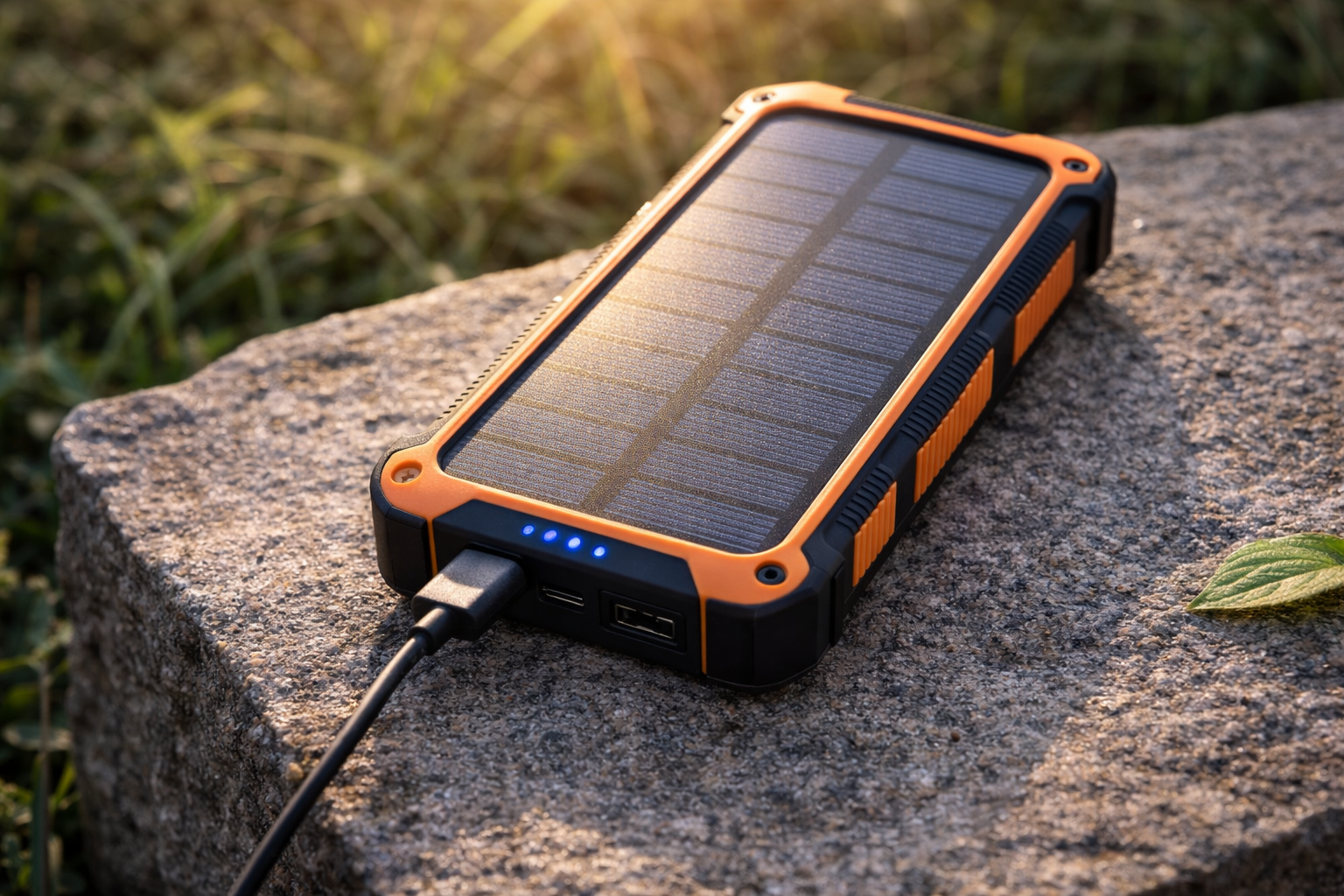
Solar power banks work — but the built-in solar panel on most models is far too small to be a primary charging source. A typical built-in panel produces 0.5W to 2W, which means fully charging a 10,000mAh battery from solar alone would take 50 hours or more of direct sunlight. The solar feature is best understood as a slow top-up mechanism, not a replacement for wall charging. Whether that makes a solar power bank worth buying depends entirely on how you plan to use it.
Quick Answer
- Built-in solar panels on most power banks produce 0.5W–2W — enough to add a few percent of charge per hour, not a full recharge
- Real-world solar output is 30–50% of the panel’s rated wattage due to angle, heat, and cloud cover
- A 10,000mAh bank needs roughly 15–20Wh of energy to charge — a 2W panel needs 50+ hours of sun to deliver that
- Solar power banks are genuinely useful for multi-day outdoor use as a supplement to a full wall charge, not as a standalone charging solution
How Solar Panels on Power Banks Actually Work
The Panel Size Problem
A foldable solar panel designed for serious off-grid use measures 20–40cm unfolded and produces 10–28W. The solar panel embedded in a pocket-sized power bank covers a surface area roughly the size of a credit card — and physics limits how much power that surface can generate.
Most built-in panels fall between 0.5W and 2W. Some manufacturers list higher ratings (5W is common in marketing copy), but those figures reflect peak laboratory conditions with the panel held at an optimal angle under ideal irradiance. Real-world output is typically 30–50% of that number.
A 5W panel producing 2.5W of usable power in direct sunlight needs 6–8 hours of sun to add 15Wh — enough to charge a 10,000mAh bank once, if everything is perfect. In practice, sun angles shift, clouds pass, and the panel rarely sits at the optimal angle for the full exposure window.
The Conversion Efficiency Layer
Solar energy goes through two conversion steps before it reaches a stored charge:
- Photovoltaic conversion — sunlight to electricity. Consumer-grade monocrystalline cells convert roughly 20–23% of incoming light energy into electrical energy.
- Charging circuit efficiency — electricity to stored battery capacity. Lithium battery charging circuits lose roughly 10–20% in the process.
Combined, only about 16–19% of the solar energy hitting the panel ends up stored in the battery. This is why solar charging times feel so slow — they are.
What the Numbers Look Like in Practice
| Power bank capacity | Energy needed to charge | 1W panel (ideal sun) | 2W panel (ideal sun) |
|---|---|---|---|
| 5,000mAh | ~7.5Wh | ~37 hours | ~19 hours |
| 10,000mAh | ~15Wh | ~75 hours | ~37 hours |
| 20,000mAh | ~30Wh | ~150 hours | ~75 hours |
These figures assume constant ideal-angle direct sunlight, which doesn’t exist in practice. Realistic figures are 2–3× longer once cloud cover, angle variation, and heat losses are factored in.
The calculation uses a 70% efficiency factor for battery storage: a 10,000mAh bank rated at 3.7V holds approximately 37Wh of energy at cell level, but because power banks output at 5V, charging circuit losses mean the usable energy input needed from the solar panel is around 15Wh. I explain how mAh translates to actual stored energy in a separate guide.
When Solar Power Banks Are Genuinely Useful
Despite the limitations above, solar power banks serve a real purpose in specific situations.
Multi-Day Off-Grid Use
The correct mental model is this: charge the power bank to 100% from a wall outlet before leaving. Use that stored charge for devices throughout a camping trip or multi-day hike. Use the solar panel to slowly recover some of what was used each day.
A 2W panel producing 1W of real output over 5 hours of outdoor activity adds roughly 5Wh — about 1,300mAh of recovered capacity. That won’t replace a full charge, but it can meaningfully extend a power bank’s useful life across a 3–5 day trip.
Emergency Preparedness
For emergency kits, a solar power bank left on a windowsill can maintain a partial charge over weeks without any wall access. Even slow trickle charging has value when the alternative is a completely dead battery.
What Solar Power Banks Cannot Replace
Solar power banks are not a practical choice for:
- Daily commuters who want to avoid carrying a cable (wall charging remains 20–50× faster)
- Anyone expecting to charge a laptop from solar — the combination of slow solar input and high laptop power demand makes this impractical except with dedicated high-wattage foldable panels
- People in regions with frequent overcast conditions during the relevant season
Built-In Panel vs. Separate Foldable Solar Panel
A better solar charging setup for serious use: a conventional high-capacity power bank paired with a separate foldable solar panel rated at 10–28W.
Foldable panels in the 15–28W range can realistically charge a 10,000mAh bank in 3–5 hours of good direct sunlight — compared to 30–75 hours for a built-in 1–2W panel. The tradeoff is carrying two pieces of gear instead of one. Not sure what capacity to pair it with? My mAh size guide breaks it down by use case.
| Setup | Solar input | Time to charge 10,000mAh | Portability |
|---|---|---|---|
| Built-in 1W panel | ~0.5W real | 75+ hours | One device |
| Built-in 2W panel | ~1W real | ~37 hours | One device |
| 10W foldable panel | ~4–5W real | ~8–10 hours | Two devices |
| 20W foldable panel | ~8–10W real | ~4–5 hours | Two devices |
The MPPT (Maximum Power Point Tracking) controller in higher-quality foldable panels continuously adjusts to extract maximum power as light conditions change. Budget panels without MPPT lose significant efficiency when clouds partially shade the panel.
Common Mistakes
Expecting solar to fully recharge the bank each day. Most users are disappointed when a built-in panel adds 5–10% charge after a full day outdoors. This is working as designed — it’s supplemental recovery, not a primary power source.
Leaving the bank face-up flat on a surface. A panel lying flat captures significantly less energy than one angled toward the sun. The optimal angle is perpendicular to incoming sunlight, which changes throughout the day. Even propping the power bank at a 30–45° angle toward south (in the northern hemisphere) improves output measurably.
Charging through glass. UV-filtering glass in windows and car windshields blocks a significant portion of the light spectrum that solar cells use. Output through glass can drop 50% or more compared to direct outdoor exposure.
Confusing output speed with solar input speed. A power bank might output 20W to charge your phone quickly — that’s the discharge speed. The solar input is typically 1–2W. These are entirely separate specifications.
Expecting cloudy days to contribute meaningfully. Overcast conditions reduce solar panel output by 70–90% compared to direct sun. A panel producing 1W in full sun may produce 0.1–0.3W under cloud cover.
Frequently Asked Questions
Can a solar power bank charge itself while simultaneously charging my phone?
Yes, most support pass-through charging (charging a device while the bank itself charges). The solar input is so slow relative to device power draw that the bank will still net-discharge while charging a phone. The solar contribution is negligible in real time.
How long does it take to charge a 20,000mAh solar power bank from solar only?
With a typical 1–2W built-in panel, expect 50–150 hours of ideal direct sunlight — effectively impossible as a single charge session. A separate 20W foldable panel reduces this to roughly 8–12 hours of good sun. Wall charging remains the only practical way to fully charge a 20,000mAh bank.
Do solar power banks work on cloudy days?
Yes, but output drops 70–90% compared to direct sunlight. Overcast conditions add only trace amounts of charge over a day.
Is a solar power bank allowed on airplanes?
The airline rules for solar power banks are identical to standard power banks — the lithium battery capacity determines whether it’s permitted. The solar panel itself is irrelevant to airline regulations.
What wattage solar panel do I need to actually charge a power bank in a day?
To charge a 10,000mAh bank in 5–6 hours of direct sunlight, the panel needs to deliver roughly 3–4W of real output — which means a rated output of at least 8–10W to account for real-world losses. A 10W or higher foldable panel can meet this threshold; the built-in panels on most solar power banks cannot.
Summary
Solar power banks work, but their built-in panels are too small to serve as a primary charging method for any reasonable battery capacity. A built-in 1–2W panel adds useful charge across a multi-day outdoor trip when combined with a full wall charge before departure. For faster solar charging, a separate foldable panel with MPPT regulation and a rating of 10W or higher is far more effective than any built-in panel on a compact power bank.
Need help choosing?
Take the quiz