Power Bank Wh: Calculate Watt-Hours from mAh
March 12, 2026
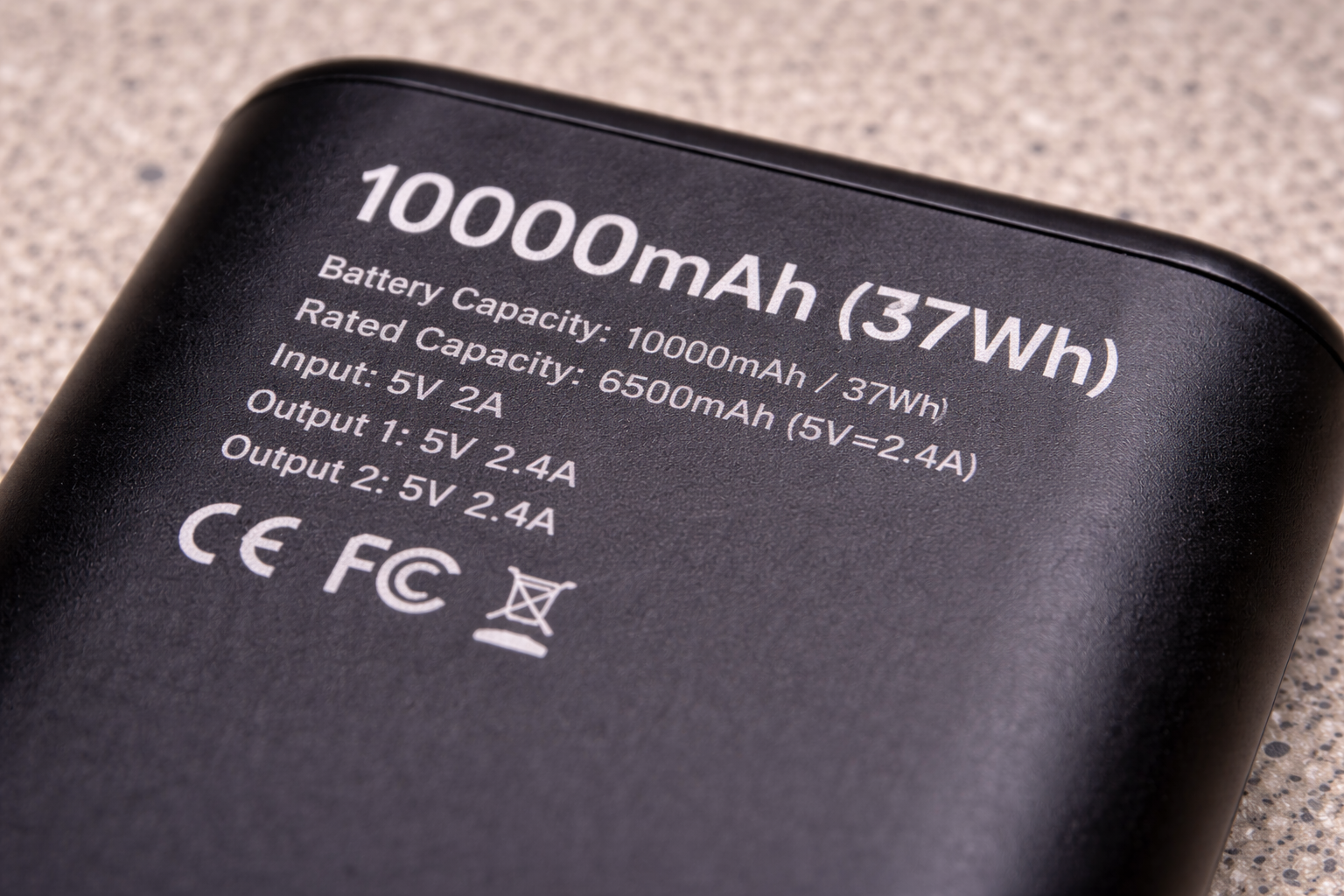
Most power banks display capacity in mAh (milliampere-hours), but airlines, laptop manufacturers, and USB Power Delivery specs all use Wh (watt-hours). Converting between the two requires one formula: Wh = (mAh × Voltage) ÷ 1000. For standard lithium-ion power banks running at 3.7V, a 20,000mAh unit equals 74Wh — well under the 100Wh airline limit. Understanding this calculation lets you verify flight compliance, estimate charging cycles, and compare power banks accurately.
Quick Answer
- Formula: Wh = (mAh × V) ÷ 1000
- Standard power bank voltage: 3.7V
-
10,000mAh = ~37Wh 20,000mAh = ~74Wh 27,000mAh = ~99.9Wh - Airline carry-on limit: 100Wh without approval; up to 160Wh with airline approval
The Formula Explained
Why Two Different Units Exist
mAh measures electrical charge — how many milliamps a battery can deliver over one hour. Wh measures energy — the actual work that charge can do. The difference matters because voltage determines how much power is delivered per unit of charge.
A 10,000mAh battery at 3.7V stores a different amount of energy than a 10,000mAh battery at 7.4V. Wh captures this distinction; mAh alone does not.
The Calculation Step by Step
Wh = (mAh ÷ 1000) × V
The ÷ 1000 step converts milliampere-hours to ampere-hours (Ah). Then multiplying by voltage gives watt-hours.
For a 20,000mAh power bank at 3.7V:
- 20,000 ÷ 1000 = 20 Ah
- 20 Ah × 3.7V = 74 Wh
What Voltage to Use
Most lithium-ion power banks use a nominal cell voltage of 3.7V. This is the standard value printed on the FAA’s battery guidance and used by manufacturers for Wh labeling.
Some power banks include multiple cells wired in series, which raises the internal voltage. However, the Wh label on the device already accounts for this — use 3.7V only when the label shows mAh but no Wh.
mAh to Wh Reference Table
| Capacity (mAh) | Voltage | Watt-Hours (Wh) | Airline Status |
|---|---|---|---|
| 5,000 | 3.7V | 18.5 Wh | ✅ Carry-on, no approval |
| 10,000 | 3.7V | 37 Wh | ✅ Carry-on, no approval |
| 20,000 | 3.7V | 74 Wh | ✅ Carry-on, no approval |
| 25,000 | 3.7V | 92.5 Wh | ✅ Carry-on, no approval |
| 27,000 | 3.7V | 99.9 Wh | ✅ Carry-on, no approval |
| 30,000 | 3.7V | 111 Wh | ⚠️ Airline approval required |
| 40,000 | 3.7V | 148 Wh | ⚠️ Airline approval required |
| 50,000 | 3.7V | 185 Wh | ❌ Not permitted on aircraft |
Why Wh Matters More Than mAh
Airline Regulations Use Wh
The FAA, TSA, and IATA all regulate lithium-ion batteries by watt-hours, not mAh. Per FAA guidelines:
- 0–100 Wh: Permitted in carry-on baggage, no approval needed
- 101–160 Wh: Permitted in carry-on with airline approval (maximum two batteries)
- Over 160 Wh: Not permitted on passenger aircraft
This is why a 27,000mAh power bank (99.9Wh) passes without issue, while a 30,000mAh unit (111Wh) requires pre-flight approval from your airline. The mAh number alone gives no direct indication of compliance. I cover the full airline rules for power banks here.
Laptop Charging Compatibility
USB Power Delivery chargers and laptop documentation specify power in watts (W) and energy in watt-hours (Wh). Knowing your power bank’s Wh rating tells you whether it can meaningfully charge a laptop.
A 15-inch laptop with a 99.9Wh internal battery, for example, needs approximately 100Wh of input to reach a full charge — accounting for conversion losses, closer to 140Wh of power bank capacity. A 74Wh power bank would deliver roughly a 50% charge at best. I break down the efficiency math in my mAh size guide.
Comparing Power Banks Accurately
Two power banks can show the same mAh rating but differ in actual energy storage if their internal voltages differ. Wh is the only figure that allows direct comparison across different models and cell configurations.
Reverse Calculation: Wh to mAh
If a power bank shows Wh but not mAh, reverse the formula:
mAh = (Wh × 1000) ÷ V
Example: A 99.9Wh power bank at 3.7V:
- 99.9 × 1000 = 99,900
- 99,900 ÷ 3.7 = ~27,000 mAh
This is useful when evaluating laptop battery packs or older devices that only display Wh on their labels.
Common Mistakes
Using the wrong voltage. Applying 5V (USB output voltage) instead of 3.7V (cell voltage) gives an inflated result. The formula uses the battery’s internal cell voltage, not the charging port voltage.
Confusing rated capacity with delivered capacity. A 20,000mAh power bank rated at 74Wh will not transfer 74Wh to your device. Conversion losses — typically 10–30% depending on charging protocol and cable quality — reduce usable output. Expect roughly 50–65Wh of energy to actually reach your device. For a deeper look at what mAh actually measures, see my explainer.
Assuming the Wh label is always accurate. Budget power banks sometimes overstate mAh ratings. The Wh label, when present, is more regulated and generally more reliable — particularly on units sold in the EU, where IEC labeling standards apply.
Ignoring voltage when comparing across brands. Some high-capacity power banks use 3.8V cells rather than 3.7V. The difference is small but worth checking if precision matters — for example, when calculating compliance with a strict 100Wh airline limit.
Frequently Asked Questions
My power bank doesn’t show Wh anywhere — what voltage should I use?
Use 3.7V. This is the nominal voltage for the lithium-ion cells used in virtually all consumer power banks and is the value airlines and the FAA use for compliance calculations.
Is a 27,000mAh power bank allowed on a plane?
At 3.7V, 27,000mAh equals 99.9Wh — just under the 100Wh carry-on limit. It is permitted in carry-on baggage without airline approval under FAA and IATA guidelines. It cannot go in checked baggage.
Can I add up two power banks’ Wh ratings to check total capacity?
For counting purposes, yes. Each power bank is assessed individually against the 100Wh limit. You can carry multiple power banks under 100Wh each without special approval. The 101–160Wh range is limited to two units total with airline approval.
Why does my 20,000mAh power bank only charge my phone 3–4 times instead of the expected 5–6?
Conversion losses. Your power bank outputs 5V via USB while its cells operate at 3.7V. The voltage step-up circuit loses energy — typically 15–25%. Real-world output is closer to 60–70% of the rated mAh. This is normal across all lithium-ion power banks, regardless of brand.
Does a higher Wh rating always mean more charges?
Yes, proportionally. A 74Wh power bank delivers roughly twice the usable energy of a 37Wh unit. The number of device charges depends on the device’s battery capacity and the power bank’s conversion efficiency.
Summary
Watt-hours = (mAh × voltage) ÷ 1000. For most power banks, use 3.7V as the voltage. This single calculation determines airline compliance, realistic charging expectations, and accurate capacity comparisons between devices. The 100Wh threshold — equivalent to roughly 27,000mAh — is the practical ceiling for carry-on travel without additional airline approval.
Need help choosing?
Take the quiz