How Long Do Power Banks Last? Lifespan Guide
March 05, 2026
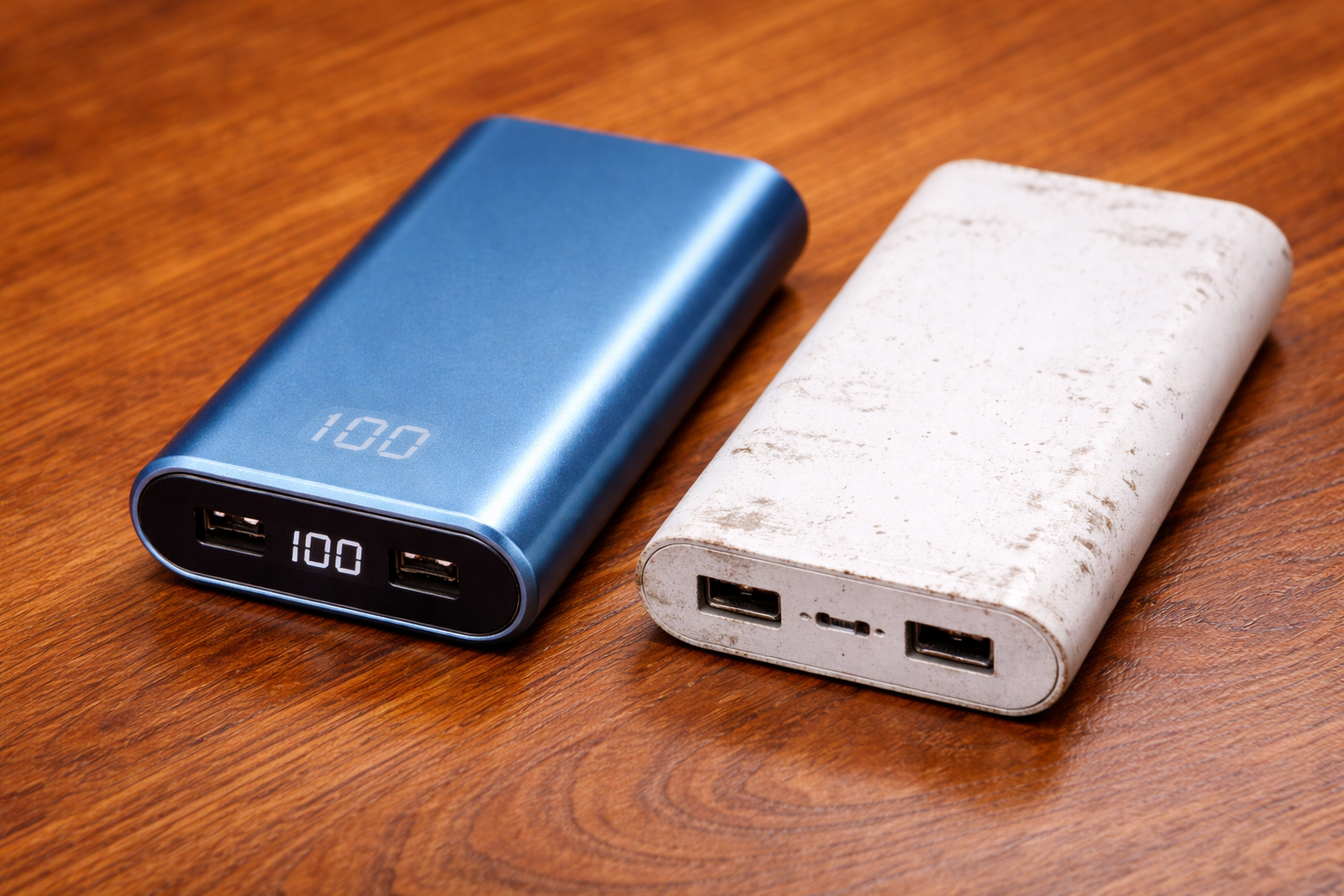
Most power banks last 2–4 years, or 300–500 full charge cycles, before capacity degrades noticeably. Budget models often fall short of that range, while quality units with proper care can reach 4–5 years. Lifespan depends on three main variables: charge cycle count, heat exposure, and depth of discharge. This article explains how each factor works and what you can do to extend your power bank’s usable life.
Quick Answer
- Standard power banks are rated for 300–500 charge cycles
- That translates to roughly 2–3 years of regular daily use
- After 500 cycles, expect 15–20% capacity loss — the bank still works, just holds less charge
- Heat and full discharges accelerate degradation faster than cycle count alone
- Higher-capacity banks (20,000mAh+) tend to last longer in calendar years because they cycle less frequently per use
What Is a Charge Cycle?
A charge cycle is one full equivalent of 0–100% charge and 0–100% discharge — but it doesn’t have to happen in a single session. Using 50% of the battery today and the remaining 50% tomorrow counts as one complete cycle.
This distinction matters for higher-capacity power banks. A 20,000mAh bank used to top off a single smartphone (roughly 4,000mAh) only consumes about 20–25% of its capacity per session. That means five sessions equal one charge cycle. The same 500-cycle rating stretches across far more real-world uses compared to a 5,000mAh bank doing full discharges.
Cycle Ratings by Capacity (Estimated Real-World Uses)
| Power Bank Capacity | Charge Cycles Rated | Phone Charges Per Cycle (4,000mAh phone) | Estimated Total Phone Charges |
|---|---|---|---|
| 5,000mAh | 300–500 | ~1 | 300–500 |
| 10,000mAh | 300–500 | ~2 | 600–1,000 |
| 20,000mAh | 300–500 | ~4 | 1,200–2,000 |
Note: Figures use a 70% efficiency factor. Power banks lose approximately 30% of stored energy to heat and conversion during output. I break down exact charge counts per device in my mAh size guide.
How Capacity Degrades Over Time
Lithium-ion batteries — the type used in nearly all power banks — degrade through a process called SEI layer formation. As lithium ions move between the cathode and anode during each cycle, a thin film builds up on the electrode surfaces. Over time, this film thickens and restricts ion movement, reducing the total charge the battery can hold.
The degradation is gradual, not sudden. A typical power bank retains 80–90% of its original capacity after 300–500 cycles. A unit that shipped at 10,000mAh might measure around 8,000–9,000mAh after reaching its rated cycle count — still functional, just with reduced output.
Most power banks also lose 5–10% of stored charge per month when sitting idle. Storing a fully charged or fully depleted bank accelerates this self-discharge rate.
Year-by-Year Capacity Estimate (20,000mAh Example, Regular Use)
| Year | Estimated Capacity | Notes |
|---|---|---|
| Year 0 (new) | 20,000mAh | Factory rated |
| Year 1 | 18,000–19,000mAh | ~5–10% loss |
| Year 2 | 16,000–17,000mAh | ~15–20% loss |
| Year 3 | 14,000–16,000mAh | Noticeable decline |
| Year 4+ | Varies | Depends on usage and storage conditions |
Factors That Shorten Power Bank Lifespan
Heat
Heat is the single biggest accelerant of battery degradation. Charging in hot environments, leaving a power bank in a car, or placing it in direct sunlight all permanently reduce cell capacity — not just temporarily. Lithium-ion chemistry is stable up to around 35°C (95°F); above that, accelerated aging begins.
Fast charging (high wattage output) also generates internal heat. This is a secondary reason why constantly drawing maximum watts from a power bank — running a laptop at 100W, for example — adds more cumulative stress than slower phone charging.
Full Discharges
Draining a lithium-ion battery to 0% triggers deeper chemical stress than partial discharges. Batteries cycled between 20–80% consistently outlast those regularly taken to empty. Allowing a power bank to sit fully discharged for extended periods can cause voltage to drop below the battery management system’s (BMS) recovery threshold, potentially rendering the bank unresponsive.
Overcharging (Long-Term)
Modern power banks include protection circuits that stop charging at 100%. However, leaving a bank plugged in continuously — especially at high ambient temperatures — maintains the battery at maximum voltage, which accelerates degradation at the cathode level. Unplugging once fully charged is the cleaner habit.
Battery Cell Quality
Not all lithium cells are equal. Budget power banks use lower-grade cells with less consistent chemistry and thinner separators. Premium cells handle deep discharge and thermal variation better, which directly extends cycle life. This is one reason identically-rated power banks from different manufacturers have meaningfully different lifespans.
How to Extend Power Bank Lifespan
These habits have a measurable effect on how long your power bank remains at full utility:
Recharge before 20%. Partial discharges put less stress on cells than running to empty. The sweet spot for longevity is cycling between 20–80%.
Store at 50% charge. If the bank will sit unused for weeks or months, charge it to 50% before storing. Recharge every 90 days to prevent deep discharge.
Keep it cool. Avoid charging in direct sunlight, hot cars, or near heat sources. Ambient temperature matters more than most users realize.
Use certified cables and chargers. Uncertified accessories can deliver unstable voltage or amperage, which increases thermal stress on the BMS and cells.
Avoid parasitic drain. Some power banks draw a small current continuously to power LEDs or pass-through features. If the bank won’t be used for an extended period, disable any always-on features if the model supports it.
Signs a Power Bank Is Nearing End of Life
Capacity degradation is gradual, but these are reliable indicators the bank has significantly aged:
- Charges a device fewer times than it used to (e.g., previously charged a phone three times, now only twice)
- Gets noticeably warmer during charging or discharging than when new
- Takes longer to recharge from a wall outlet
- Displays inaccurate charge level (e.g., jumps from 40% to 0% without warning)
- Physical swelling of the casing — this is a safety concern requiring immediate disposal through a battery recycling program
Common Mistakes
Assuming more mAh means longer lifespan. Capacity (mAh) and cycle life are separate specs. A 20,000mAh bank with 300-cycle cells will outlast a 5,000mAh bank with 500-cycle cells in total energy delivered over its lifetime, but not necessarily in years.
Ignoring self-discharge during storage. A power bank stored fully charged or fully depleted for six months will arrive in worse condition than one stored at 50%. This matters most for emergency or travel-only units.
Treating all lithium batteries the same. Lithium-polymer (Li-Po) and lithium-ion (Li-ion) cells behave similarly in terms of cycle degradation, but Li-Po batteries are more sensitive to swelling from mechanical stress. The care principles are the same, but Li-Po banks warrant more caution around pressure and bending.
Expecting the rated cycle count to be a cliff edge. A power bank at 500 cycles doesn’t stop working — it simply holds less charge. Many remain usable well past their rated cycle count, just with reduced capacity.
Frequently Asked Questions
How many years does a power bank last?
Most quality power banks last 2–4 years with regular use. Banks used only for travel or emergencies can last 4–5 years because they accumulate cycles more slowly.
Does leaving a power bank plugged in overnight damage it?
Modern units include overcharge protection that stops current once full. Occasional overnight charging isn’t harmful, but habitually leaving any lithium battery at 100% charge — especially in warm conditions — accelerates long-term degradation.
Can a power bank be restored after going completely dead?
If the bank discharged to 0% and sat unused for a long period, the battery may have dropped below the BMS recovery threshold. Some banks can be revived by connecting them to a power source for 30–60 minutes. Others may not respond. Storing at 50% charge prevents this scenario.
Does fast charging reduce power bank lifespan?
Higher wattage output generates more heat, which does accelerate degradation slightly. The difference is more relevant for the devices being charged (which receive the high-wattage input) than for the power bank itself, provided the bank’s thermal management handles the load without excessive heating.
How do I know when to replace a power bank?
Track how many times it charges a specific device. If that number drops to roughly 50–60% of what it managed when new, the battery has degraded significantly. Physical swelling is an immediate replacement signal regardless of apparent charge performance. When it’s time for a new one, the power bank quiz can help you pick a replacement in under a minute.
Summary
Power banks last 300–500 charge cycles, which translates to 2–4 years for most users. Capacity declines gradually — typically 15–20% by the end of rated cycle life — rather than stopping abruptly. Heat and full discharges degrade cells faster than cycle count alone. Storing at 50% charge, avoiding high-temperature environments, and recharging before 20% are the most effective habits for extending usable life.
Need help choosing?
Take the quiz