Power Bank Flight Rules by Country (2025–2026)
April 16, 2026
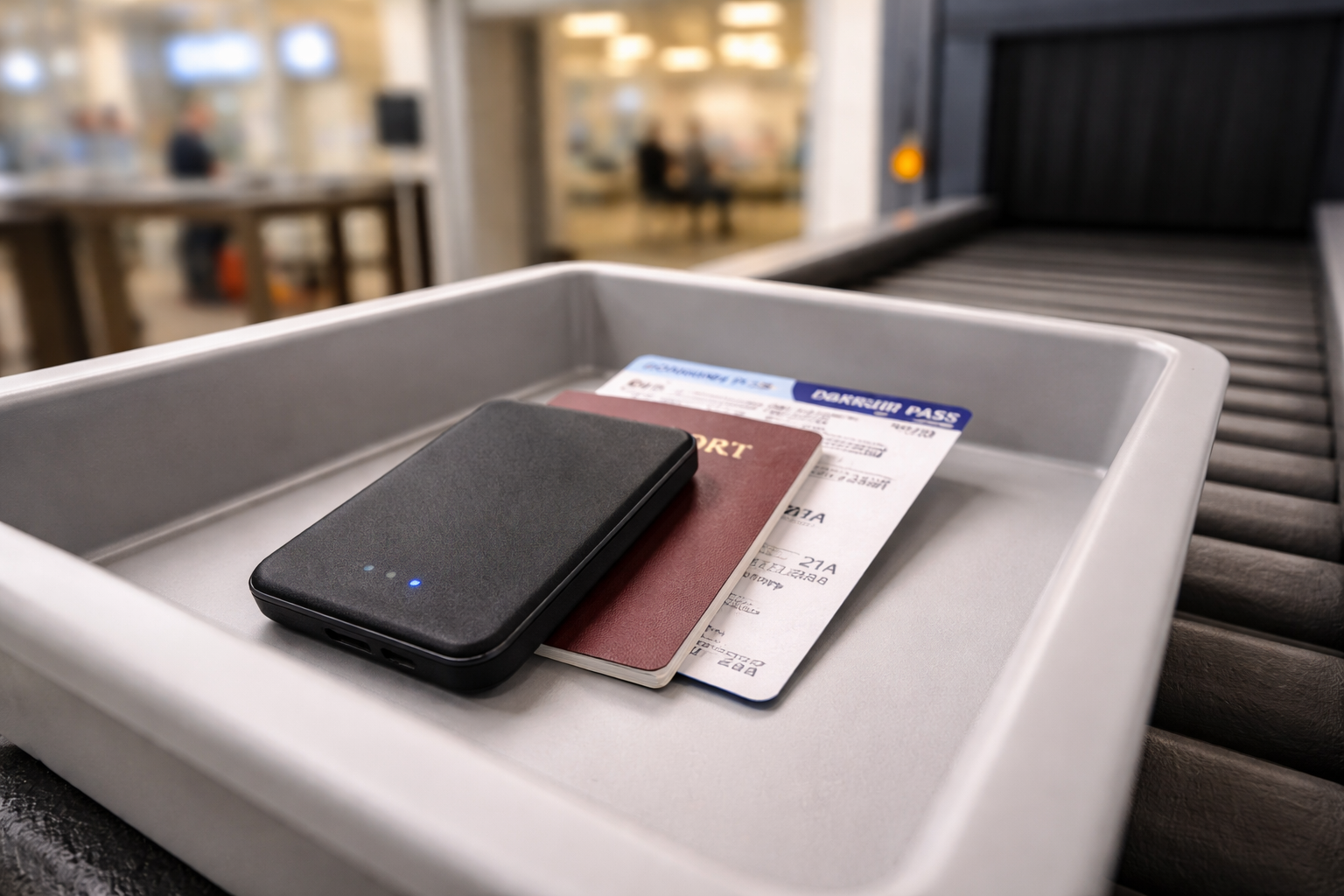
Power banks are classified as spare lithium-ion batteries under international aviation law, which means they are banned from checked baggage on all commercial flights worldwide and must travel in carry-on luggage only. The universal capacity limit is 100Wh (roughly 27,000 mAh) without special approval — anything above that enters restricted territory. But since 2025, several countries and airlines have layered additional rules on top of this baseline.
This article covers the Wh/mAh limits, country-specific certification requirements, in-flight usage restrictions, and what happens if your power bank doesn’t meet the local rules.
Quick Answer
- Power banks must go in carry-on luggage — never checked baggage, on all flights worldwide
- Under 100Wh (~27,000 mAh): permitted on virtually all flights with no approval needed
- 100–160Wh: allowed on most airlines with prior airline approval, max 2 units per person
- Over 160Wh: banned from all commercial passenger aircraft
- China now requires a 3C certification mark for domestic flights (since June 28, 2025)
- Most Asian and Australian airlines now prohibit in-flight use and overhead bin storage
The Universal Baseline: How Wh Limits Work
Aviation authorities regulate power banks based on watt-hours (Wh), not the mAh figure printed on most consumer devices. The International Air Transport Association (IATA), the FAA (USA), and EASA (EU) all use the same three-tier framework:
| Capacity | Status |
|---|---|
| 0–100 Wh | Permitted in carry-on, no approval needed |
| 101–160 Wh | Permitted in carry-on with airline approval, max 2 units |
| Over 160 Wh | Prohibited on all commercial passenger flights |
Most consumer power banks operate at 3.7V nominal voltage. The formula to convert mAh to Wh:
Wh = (mAh × 3.7) ÷ 1,000
Practical reference points:
| mAh Rating | Approximate Wh | Flight Status |
|---|---|---|
| 10,000 mAh | 37 Wh | ✅ No restrictions |
| 20,000 mAh | 74 Wh | ✅ No restrictions |
| 26,800 mAh | ~99 Wh | ✅ No restrictions (just under limit) |
| 27,000 mAh | ~100 Wh | ✅ Borderline — verify airline policy |
| 30,000 mAh | ~111 Wh | ⚠️ Requires airline approval |
| 43,000 mAh | ~160 Wh | ⚠️ Requires approval (maximum allowed) |
| 50,000 mAh | ~185 Wh | ❌ Banned |
If the Wh rating is not printed on the device, security may confiscate it even if it’s technically within the limit. Always verify the label is legible before travel. If only mAh is shown, calculate the Wh yourself and keep the original packaging with the full specification.
Why Carry-On Only?
Lithium-ion batteries are capable of thermal runaway — a self-sustaining chemical reaction that produces intense heat, smoke, and fire without warning. The FAA documented record numbers of battery-related incidents in 2024–2025.
Cargo holds lack the fire detection and suppression systems available in passenger cabins. Flight crews are trained to manage battery fires in the cabin; they cannot respond to an incident in the hold. This is why every aviation authority worldwide, without exception, bans power banks from checked luggage — including smart luggage with built-in batteries.
If your carry-on is gate-checked at the jetway, remove the power bank before handing the bag over and keep it with you in the cabin.
Country and Region Rules (2025–2026)
United States (FAA / TSA)
The FAA and TSA apply the standard IATA framework with no additional restrictions beyond the Wh tiers. Power banks must be in carry-on baggage only. There is no quantity limit on sub-100Wh units for personal use. Batteries carried for resale or commercial distribution are prohibited regardless of capacity.
In-flight use is not regulated at the federal level — individual airline policies apply.
European Union (EASA)
EU member states follow EASA guidelines, which align with IATA’s baseline. Under 100Wh with no restriction, 100–160Wh with airline approval, over 160Wh banned. Most major European carriers (Lufthansa, Air France, KLM, Ryanair, easyJet) currently allow in-flight use and overhead bin storage for compliant power banks. Power bank terminals must be protected from short circuits, and devices with unclear capacity labels may be refused at security.
China (CAAC) — New Rules Effective June 28, 2025
China now has the most prescriptive power bank regulations globally. In addition to the standard Wh limits, the Civil Aviation Administration of China (CAAC) introduced a mandatory certification requirement for domestic flights.
Requirements for flights within China:
- The power bank must display the CCC mark (China Compulsory Certification, also written as “3C”) — three letters enclosed in an oval
- Capacity must be clearly printed on the device
- Maximum 2 power banks per passenger
- In-flight use is prohibited — device must remain switched off throughout the flight
- Charging via aircraft USB ports or in-seat outlets is prohibited
Critical distinction: The CCC mark is not the same as the CE mark (European Conformity). A power bank with only a CE mark will be confiscated at Chinese airport security — including reputable international brands and devices physically manufactured in China. Products made for export meet CE or FCC standards, not CCC.
The CCC requirement formally applies to domestic Chinese flights. In practice, travelers report confiscations on international flights departing Chinese airports, particularly on itineraries with a domestic connecting leg. If traveling to or through China, purchase a CCC-certified power bank inside China (available from Xiaomi, Huawei, Baseus, and Anker stores in-country) or verify certification before departure.
South Korea
Following an Air Busan fire incident in January 2025 — where a portable battery pack ignited on the ground at Gimhae International Airport — South Korea’s aviation authority introduced stricter rules in March 2025 that other Asian carriers subsequently adopted:
- Power banks must be stored in the seat pocket or under the seat, not in overhead bins
- In-flight use and charging are banned
- Port terminals must be covered with tape or a protective pouch
- Korean Air, Asiana, and Air Busan all enforce these rules
Japan
Japan’s Ministry of Land, Infrastructure, Transportation and Tourism issued a directive prohibiting overhead bin storage of power banks. Devices must be kept with the passenger in the seat pocket or under the seat in front. Standard Wh limits apply.
Hong Kong
The Civil Aviation Department mandated that local airlines prohibit in-flight use, charging, and overhead bin storage (effective April 7, 2025). Power banks must be kept in the seat pocket or under the seat.
Singapore
Singapore Airlines and Scoot ban in-flight use and charging of power banks entirely. Standard capacity limits apply. Overhead bin storage is currently allowed.
India (DGCA)
India’s Directorate General of Civil Aviation prohibits in-flight use and charging of power banks. Devices must remain switched off and in personal possession throughout the flight.
Australia
Qantas introduced updated safety measures effective December 15, 2025, following collaboration with IATA and Oneworld carriers:
- In-flight use is prohibited
- Charging via in-seat power or USB ports is prohibited
- Maximum 2 power banks per passenger, each not exceeding 160Wh
- Devices must be kept in the seat pocket or under the seat in front
- Power banks without visible Wh or mAh specifications are treated as prohibited items
Asian Airline Summary Table
| Airline / Region | In-Flight Use | Overhead Bin | Notes |
|---|---|---|---|
| Emirates | Banned | Allowed | Max 1 power bank under 100Wh |
| Malaysia Airlines | Banned | Banned | Seat pocket or under-seat only |
| AirAsia | Banned | Banned | Seat pocket or seat-back pocket only |
| Thai Airways | Banned | Allowed | Rules updated March 15, 2025 |
| EVA Air / China Airlines | Banned | Allowed | May require insulated ports at some airports |
| Cathay Pacific / HK Express | Banned | Banned | Under-seat storage only |
| Singapore Airlines / Scoot | Banned | Allowed | Standard Wh limits apply |
| Korean Air / Asiana / Air Busan | Banned | Banned | Ports must be covered; under-seat only |
What “Airline Approval” Means for 100–160Wh Devices
Most airlines do not have a formal pre-travel approval process for 100–160Wh power banks. In practice, approval means the Wh rating is clearly marked on the device and verifiable by security staff on the day. Some airlines list prior approval as available through their customer service lines.
Arriving at the gate with an unlabeled large-capacity power bank and expecting clearance is unreliable. If the Wh cannot be verified, security has grounds to confiscate the device regardless of its actual capacity.
Practical Checklist Before Flying
Before you pack:
- Find the Wh rating printed on the device — if only mAh is shown, calculate Wh as (mAh × 3.7) ÷ 1,000
- Confirm the rating label is legible and not scratched or faded
- If flying to or through China, verify the CCC mark is present (not just CE)
- Check your specific airline’s current policy page — rules changed significantly in 2025
At the airport:
- Keep power banks in carry-on luggage only, never checked bags
- If your carry-on is gate-checked, remove the power bank before handing over the bag
- Have the device accessible — security may ask you to present it separately
During the flight:
- If your airline prohibits in-flight use, keep the device switched off in your seat pocket or under the seat in front
- Do not charge via power bank while connected to aircraft USB ports where prohibited
- Cover charging ports with tape or a protective case on South Korean carriers
Frequently Asked Questions
Can I bring two power banks on a plane?
Yes, for sub-100Wh devices, most airlines allow multiple units. For 100–160Wh devices, the limit is strictly two per passenger with airline approval.
What happens if my power bank has no Wh label?
Security may confiscate it. Without a verifiable capacity rating the device cannot be confirmed as compliant. If your device only shows mAh, carry original packaging with the full specification, or calculate and label the Wh value yourself.
Are the rules the same for domestic and international flights?
The Wh limits are consistent globally. China’s 3C certification requirement formally applies to domestic Chinese flights, though enforcement extends to international departures from Chinese airports in practice. In-flight usage rules vary by airline rather than by route.
My power bank is 20,000 mAh. Is it allowed?
At 3.7V, 20,000 mAh is approximately 74Wh — well under the 100Wh threshold. It is permitted on virtually all commercial flights in carry-on luggage with no approval needed. Exception: flights within China also require a visible 3C certification mark.
Can I charge my phone from a power bank during the flight?
This depends entirely on your airline. US and most European carriers currently allow it. Most Asian and Australian carriers introduced bans on in-flight power bank use in 2025. Check your airline’s policy page before your flight.
What triggered the tightened rules in 2025?
An Air Busan fire in January 2025, caused by a portable battery pack igniting on the ground at Gimhae International Airport, triggered a rapid regulatory chain reaction across Asian aviation authorities. Combined with record battery incident numbers reported by the FAA in 2024–2025, the event accelerated in-flight usage bans and storage restrictions across multiple carriers.
Summary
The global baseline — under 100Wh in carry-on luggage only — applies on all commercial flights worldwide. What changed significantly in 2025 is how power banks must be stored and used during flight: most Asian and Australian carriers now ban in-flight charging and require under-seat or seat-pocket storage. China stands apart with a mandatory 3C certification requirement that catches many international travelers off guard. Before any international trip, verify the Wh rating is legible on your device, check your specific airline’s current restrictions, and — for any itinerary touching China — confirm the CCC mark.
Need help choosing?
Take the quiz