MagSafe Power Banks: How Wireless Charging Works
April 09, 2026
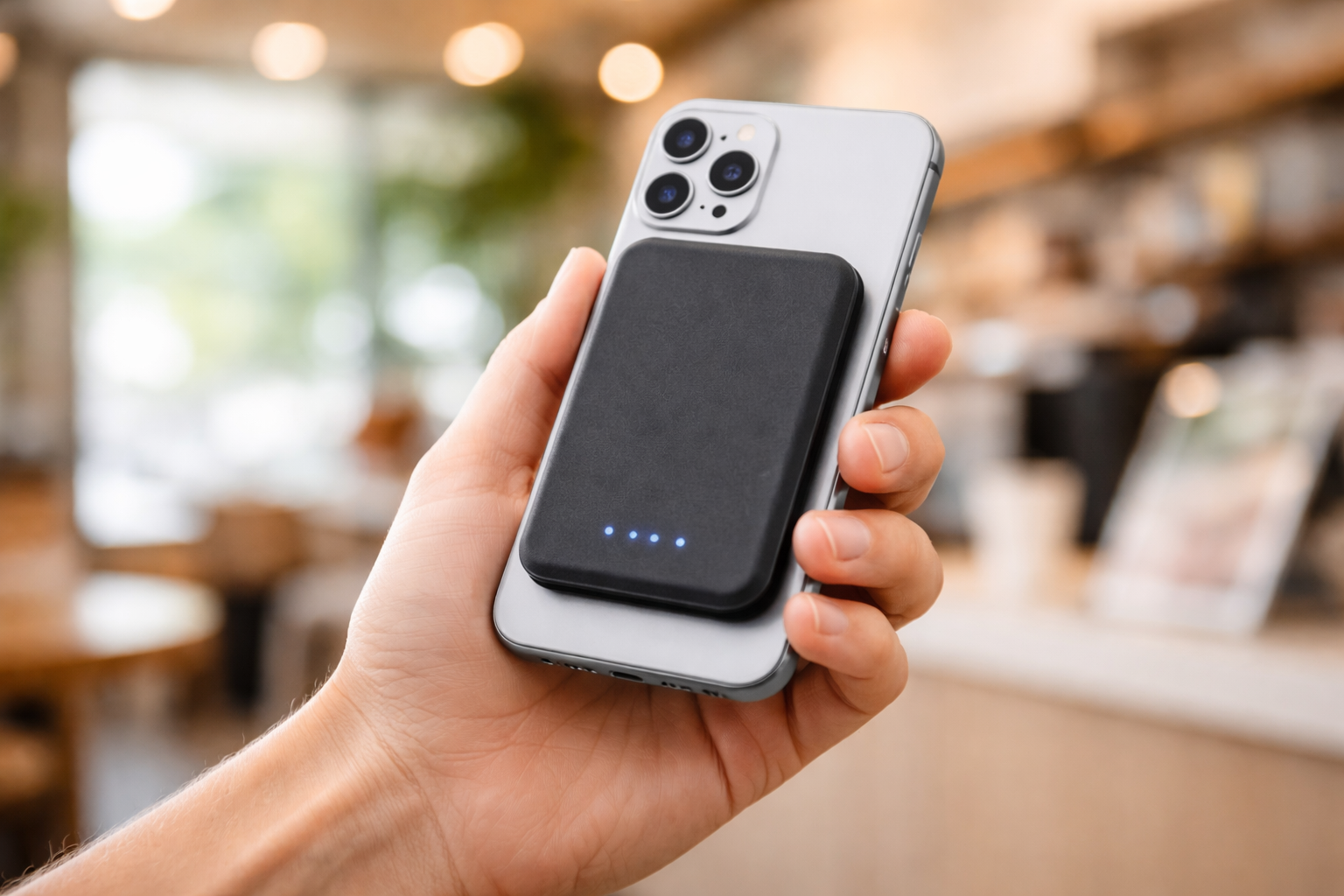
MagSafe power banks charge your iPhone by combining standard wireless induction with a ring of magnets that snap the charging coils into perfect alignment. That alignment is what separates MagSafe from regular Qi wireless charging — it eliminates misalignment, unlocks faster charging speeds, and lets you use your phone hands-free while the power bank is attached. This article explains the physics behind the technology, how it compares to Qi and Qi2, and what the wattage numbers mean in practice.
Quick Answer
- MagSafe uses electromagnetic induction to transfer power wirelessly, plus a magnet ring for precise coil alignment
- MFM-certified (Made for MagSafe) power banks deliver up to 15W wirelessly; non-certified units are limited to 7.5W
- Compatible with iPhone 12 and all newer models, except iPhone 16e
- Qi2 (launched 2023) brings the same magnetic alignment to both iPhones and Android devices
How MagSafe Wireless Charging Works
The Induction Principle
All wireless charging — MagSafe, Qi, Qi2 — relies on electromagnetic induction. An alternating current passes through a coil inside the power bank, generating a fluctuating magnetic field. A second coil inside the iPhone intercepts that field and converts it back into electrical current to charge the battery.
This process works across a very short gap of a few millimeters, which is why the two coils must be close and centered. If they drift out of alignment, energy transfer drops sharply — that’s the core limitation of basic Qi charging pads.
What the Magnets Add
Inside every MagSafe-compatible iPhone, there’s a circular array of magnets embedded around the wireless charging coil. MagSafe power banks contain a corresponding magnet ring. When the two surfaces come together, the magnets snap into place and precisely center the coils before charging begins.
This alignment produces two direct results:
- Speed: Properly centered coils transfer more energy per cycle. This is why certified MagSafe products reach 15W while a standard Qi charger is limited to 7.5W on iPhones.
- Stability: The magnetic hold maintains coil alignment during normal phone use. Scrolling, calls, and movement don’t interrupt the charging session.
The magnets themselves carry no electrical current — they only position the device. The induction coils do the actual power transfer.
MagSafe vs. Qi vs. Qi2
| Feature | Qi | MagSafe | Qi2 |
|---|---|---|---|
| Magnetic alignment | No | Yes (Apple proprietary) | Yes (open standard) |
| Max wireless speed on iPhone | 7.5W | 15W | 15W |
| Device compatibility | Universal | iPhone 12+ only | iPhone + Android |
| Certification body | Wireless Power Consortium | Apple (MFM) | Wireless Power Consortium |
Qi is the decade-old baseline standard. It uses induction coils with no magnets, so placement is manual and approximate. iPhones are capped at 7.5W on Qi chargers regardless of what the hardware supports.
MagSafe layers Apple’s proprietary magnet ring over that same Qi coil. The result is reliable 15W wireless charging, but the ecosystem is exclusive to iPhones. Third-party accessories need Apple’s Made for MagSafe (MFM) certification to negotiate the full 15W output — without it, output falls back to 7.5W.
Qi2, released in 2023 by the Wireless Power Consortium, adopts MagSafe’s magnetic alignment design as an open standard. It delivers 15W speeds and works with both iPhones and Qi2-compatible Android devices, making it the more universal path going forward.
A Note on 25W MagSafe
iPhone 16 models support up to 25W over MagSafe — but this requires Apple’s updated MagSafe wall charger and a 30W power adapter. Current MagSafe and Qi2 power banks are capped at 15W wirelessly. The 25W capability applies only to the wall-charging puck, not to portable battery packs.
Wattage in Practice: 15W vs. 7.5W
The difference between 7.5W and 15W is primarily charging time. A 15W MagSafe power bank can charge an iPhone 16 Pro to roughly 87% in approximately 2.5 hours. At 7.5W, the same charge takes considerably longer.
There’s also a conversion efficiency factor that affects effective capacity. Wireless charging involves voltage conversion and heat losses. Real-world efficiency for magnetic wireless charging is typically around 60%, meaning a 5,000mAh power bank delivers approximately 3,000mAh to the device — not 5,000mAh.
| Power bank capacity | Effective wireless output (~60%) | iPhone 15 charges (approx.) |
|---|---|---|
| 5,000mAh | ~3,000mAh | ~0.8× |
| 6,000mAh | ~3,600mAh | ~1× |
| 10,000mAh | ~6,000mAh | ~1.6× |
These estimates use the iPhone 15’s 3,349mAh battery as the reference.
Wired output from the same power bank bypasses most of these losses. Most MagSafe power banks also include a USB-C port capable of 18–20W wired output, which charges faster and more efficiently than the wireless coil for the same capacity.
MFM Certification: What It Guarantees
Made for MagSafe (MFM) is Apple’s certification program for third-party accessories. For power banks, it verifies:
- Full 15W wireless output (non-certified products are limited to 7.5W)
- Magnetic field strength sufficient to maintain a secure hold during normal use
- Compatibility with Apple’s charging negotiation protocols
Without MFM certification, a power bank may physically attach to an iPhone and charge it, but it cannot negotiate the higher power rate. The result is slower charging even if the marketing suggests otherwise.
Qi2 certification is a separate path that also unlocks 15W speeds on compatible iPhones and Android devices, without requiring Apple’s MFM program. For iPhone users, the performance outcome is equivalent.
Compatible iPhone Models
MagSafe is built into the following models:
| Series | Compatible models |
|---|---|
| iPhone 12 | 12, 12 mini, 12 Pro, 12 Pro Max |
| iPhone 13 | All models |
| iPhone 14 | All models |
| iPhone 15 | All models |
| iPhone 16 | All models except iPhone 16e |
| iPhone 17 | All models |
Older iPhones (11 and earlier) support standard Qi wireless charging but lack the magnet ring. They can’t attach magnetically to a MagSafe power bank and won’t receive alignment benefits or speeds above 7.5W.
Android phones don’t natively support MagSafe. They can use MagSafe power banks when placed inside a Qi2-compatible case or third-party magnetic case, with wireless speed determined by the device’s own charging ceiling.
Thermal Management and Battery Health
Wireless charging is less efficient than wired charging, and the conversion losses generate heat. MagSafe power banks manage this through thermal throttling — when the system detects excessive temperature, it automatically reduces output wattage to protect both devices.
This behavior is expected. It also explains why real-world charging speeds can vary from advertised figures: a phone in direct sunlight, running demanding apps while charging, will throttle sooner than a phone sitting idle.
Heat affects lithium-ion battery longevity over time, but the impact from wireless charging during normal use is incremental. Certified products include protection circuits that stop charging at 100% to prevent overcharging.
Common Misconceptions
“Any MagSafe-branded power bank delivers 15W” Only MFM-certified or Qi2-certified products reach 15W. Non-certified products with MagSafe-compatible magnets are limited to 7.5W regardless of labeling.
“MagSafe power banks only charge wirelessly” Most include a USB-C port for wired output, typically at 18–20W. Wired output is faster and more capacity-efficient than the wireless pad.
“A 10,000mAh power bank will charge my iPhone twice wirelessly” At ~60% wireless efficiency, the effective output is around 6,000mAh — enough for approximately 1.6 full iPhone 15 charges, not 2.
“The magnets will damage my credit cards” MagSafe magnets are not positioned to affect cards stored separately. Apple specifically advises against placing cards directly between the iPhone and charger, where the magnetic field is strongest.
Frequently Asked Questions
Do MagSafe power banks work through cases?
Yes, but only through cases containing a MagSafe-compatible magnet ring. A standard non-magnetic case blocks the magnetic alignment and will result in poor coil centering, slower charging, or no attachment at all.
What’s the practical difference between MagSafe and Qi2 for a power bank?
Both use magnetic alignment and deliver up to 15W on compatible iPhones. Qi2 is an open standard that also works on Qi2-capable Android devices. For iPhone-only use, performance is equivalent.
Can MagSafe power banks be used while gaming or streaming video?
Yes. The magnetic hold maintains contact during active use. Heavy processor load generates additional heat that may trigger throttling, temporarily reducing wireless charging speed.
Why is my MagSafe power bank charging slower than expected?
Common causes: non-MFM-certified product limited to 7.5W; non-magnetic case interrupting alignment; ambient heat causing throttling; or pass-through charging mode, where the power bank is simultaneously recharging itself and charging the phone, distributing available power across both.
Are MagSafe power banks allowed on airplanes?
Most fall well under the 100Wh carry-on limit set by TSA and IATA. A 5,000mAh power bank at 3.7V nominal equals approximately 18.5Wh — well within limits. Verify the Wh rating printed on the device before traveling.
Summary
MagSafe power banks use electromagnetic induction for wireless power transfer, with one key addition: a ring of magnets that centers the coils for every charge. That alignment is what enables 15W speeds on MFM or Qi2 certified devices versus 7.5W on standard Qi. Wireless charging efficiency runs around 60%, so effective capacity is lower than the mAh rating suggests. The 25W speed introduced with iPhone 16 applies to the updated MagSafe wall charger, not to portable battery packs, which remain at 15W wireless maximum.
Need help choosing?
Take the quiz