How Many mAh Do I Need? Size Guide
March 03, 2026
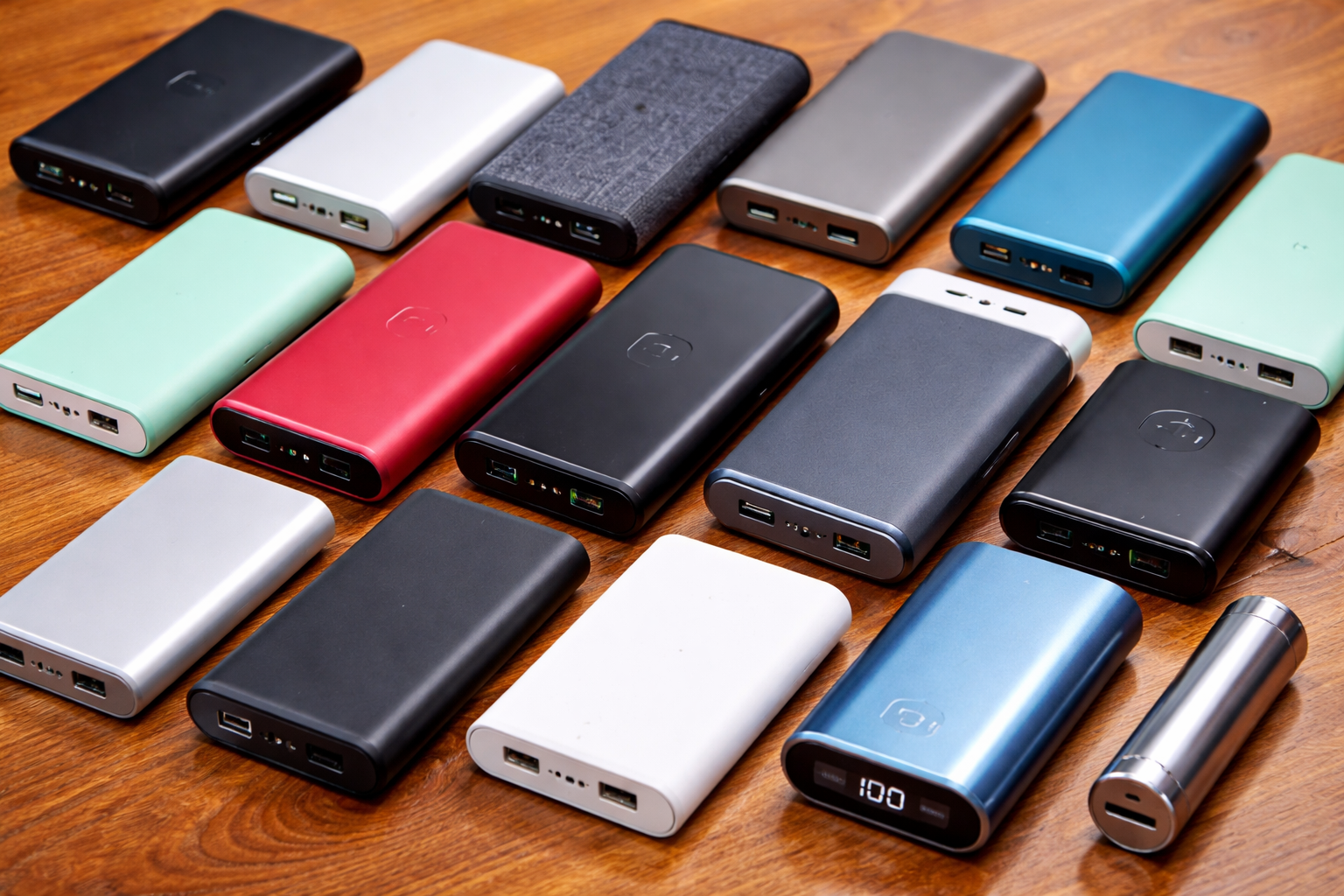
The mAh (milliampere-hours) you need in a power bank depends on your device’s battery size and how many times you want to recharge it. For most smartphone users, a 10,000mAh power bank covers 1.5–2 full charges. Heavy users or multi-device carriers should look at 20,000mAh. A quick pocket-sized backup for emergencies? 5,000mAh is enough for roughly one charge.
But raw mAh numbers on the label don’t tell the full story. Energy is lost during voltage conversion and heat, so a 10,000mAh power bank delivers roughly 6,500–7,500mAh of usable charge. This guide breaks down exactly how much capacity you need based on your devices, travel habits, and use case.
Quick Answer
- Light use (one phone, short day trips): 5,000mAh — roughly 1 full smartphone charge
- Average use (one phone, full day out): 10,000mAh — roughly 1.5–2 full smartphone charges
- Heavy use (multiple devices, long days): 20,000mAh — roughly 3.5–4 smartphone charges
- Travel / tablets / laptops: 26,800mAh — the maximum capacity allowed on most airlines
How to Calculate the Right mAh for Your Needs
Step 1: Know Your Device’s Battery Size
Every device has a battery rated in mAh. Here are the most common ones as of 2025:
| Device | Battery Capacity |
|---|---|
| iPhone 16 | 3,561 mAh |
| iPhone 16 Plus | 4,674 mAh |
| iPhone 16 Pro | 3,582 mAh |
| iPhone 16 Pro Max | 4,685 mAh |
| Samsung Galaxy S25 | 4,000 mAh |
| Samsung Galaxy S25+ | 4,900 mAh |
| Samsung Galaxy S25 Ultra | 5,000 mAh |
| iPad Pro 11” (M4) | ~8,300 mAh |
| iPad Pro 13” (M4) | ~10,340 mAh |
| Nintendo Switch (OLED) | 4,310 mAh |
| AirPods Pro case | ~523 mAh |
| Typical smartwatch | 300–500 mAh |
Not sure what battery your phone has? Search “[your phone model] battery mAh” — it’s usually listed on GSMArena or the manufacturer’s spec sheet. For a deeper explanation of what mAh actually measures, see my mAh explainer.
Step 2: Account for Conversion Loss
This is where most people get confused. A 10,000mAh power bank does not deliver 10,000mAh to your phone.
Power banks store energy at 3.7V (their internal lithium cell voltage) but output at 5V or higher via USB. This voltage conversion, combined with heat loss and circuit inefficiency, means you lose 25–35% of the rated capacity. The industry-standard estimate for real-world efficiency is about 70%.
The formula:
Usable mAh = Power bank rated mAh × 0.70
So a 10,000mAh power bank delivers roughly 7,000mAh of actual charging power. A 20,000mAh bank gives you about 14,000mAh.
Step 3: Divide and Round Down
Take the usable mAh and divide by your device’s battery:
Number of full charges = (Power bank mAh × 0.70) ÷ Device battery mAh
Example: How many times can a 20,000mAh power bank charge an iPhone 16?
20,000 × 0.70 = 14,000 usable mAh 14,000 ÷ 3,561 = 3.9 full charges
Always round down in real-world estimates. You’ll get about 3.5–4 charges.
Power Bank Size Comparison: Full Charge Counts
Here’s a practical reference table using the 70% efficiency factor:
| Power Bank | iPhone 16 (3,561 mAh) | Galaxy S25 (4,000 mAh) | Galaxy S25 Ultra (5,000 mAh) | iPad Pro 11” (~8,300 mAh) |
|---|---|---|---|---|
| 5,000 mAh | ~1.0 charge | ~0.9 charge | ~0.7 charge | — |
| 10,000 mAh | ~2.0 charges | ~1.7 charges | ~1.4 charges | ~0.8 charge |
| 20,000 mAh | ~3.9 charges | ~3.5 charges | ~2.8 charges | ~1.7 charges |
| 26,800 mAh | ~5.3 charges | ~4.7 charges | ~3.7 charges | ~2.3 charges |
Key takeaway: A 10,000mAh power bank is the sweet spot for single-phone users. It’s small enough to pocket and delivers about two full charges for most modern smartphones.
Which Size Power Bank for Which Situation?
5,000mAh: The Emergency Backup
Roughly the size of a lipstick tube or credit card stack. Fits in any pocket. Gives most phones a single charge. This is for people who forget to charge overnight or need a safety net for a night out. Not enough for a full day of heavy phone use.
Good for: commuters, evening outings, minimal packing.
10,000mAh: The Daily Driver
The most popular power bank size for a reason. Two phone charges in a package that still fits in a jacket pocket or small bag. Weighs around 200–250g. Charges most phones twice, and can top off earbuds and a smartwatch on the side.
Good for: daily carry, day trips, office workers, students. Not sure which one to get? Try the power bank quiz — it takes under 60 seconds.
20,000mAh: The Road Warrior
Noticeably heavier (350–500g) and larger. Can charge a phone 3–4 times or handle a phone plus tablet. Essential for long travel days, camping, or anyone who relies on their phone for work and can’t access outlets.
Good for: travelers, outdoor enthusiasts, multi-device users, festival-goers.
26,800mAh: Maximum Airline Capacity
The maximum capacity allowed by most airlines is 100Wh (watt-hours). At 3.7V, that equals approximately 27,027mAh — which is why 26,800mAh is the standard “max” for travel-safe power banks. I cover the full airline rules here.
Some models at this size support USB-C Power Delivery (PD) at 45W, 60W, or even 100W, making them capable of charging laptops like the MacBook Air.
Good for: international travelers, laptop charging, digital nomads, extended power outages.
Common Mistakes
Comparing raw mAh between power banks and phones. A 10,000mAh power bank doesn’t charge a 5,000mAh phone exactly twice. Voltage conversion always reduces the usable output. Always apply the ~70% efficiency factor.
Ignoring output wattage. mAh determines how many charges you get. Watts (W) determine how fast you get them. A 10,000mAh bank with 5W output charges your phone the same amount as one with 20W output — it just takes much longer. If fast charging matters to you, look for USB-C PD (Power Delivery) or QC (Quick Charge) support — here’s how PD and QC compare.
Buying too big “just in case.” A 26,800mAh power bank is heavy and takes 6–10 hours to recharge itself. If you only charge one phone per day, 10,000mAh is more practical and easier to keep topped up.
Forgetting power bank self-discharge. Lithium batteries slowly lose charge over time, even sitting idle. If you charge your power bank once a month and leave it in a drawer, it may be at 80–90% when you finally need it. Top it up before trips.
Frequently Asked Questions
Is 10,000mAh enough for a full day?
For most people, yes. A 10,000mAh power bank delivers about 7,000 usable mAh. That’s roughly two full charges for an iPhone 16 or 1.7 charges for a Galaxy S25. Combined with your phone’s built-in battery, that covers 2–3 full days of moderate use.
How many mAh do I need to charge a laptop?
Most laptop batteries range from 40Wh to 100Wh. A 26,800mAh/100Wh power bank can provide roughly 50–70% of a charge for a MacBook Air. You also need a power bank that supports USB-C PD output at a minimum of 30W — mAh alone won’t cut it for laptops. I cover this in detail in my laptop charging guide.
Does higher mAh mean slower charging?
No. Charging speed is determined by output wattage (W), not capacity (mAh). A 20,000mAh power bank with 65W PD output will charge your phone faster than a 5,000mAh bank with only 5W output.
What’s the maximum mAh allowed on a plane?
Airlines follow IATA guidelines: power banks under 100Wh (approximately 26,800mAh at 3.7V) are allowed in carry-on luggage without approval. Power banks between 100–160Wh require airline approval. Above 160Wh is prohibited. Power banks are never allowed in checked luggage. See my full guide to flying with a power bank.
Is 20,000mAh overkill?
It depends on your routine. If you charge one phone and rarely travel, 10,000mAh is enough. If you charge multiple devices, travel frequently, or use your phone heavily for work (GPS, camera, hotspot), 20,000mAh will save you from hunting for outlets.
Summary
Match your power bank to your actual usage: 5,000mAh for emergencies, 10,000mAh for daily carry, 20,000mAh for heavy or multi-device use, and 26,800mAh for travel with tablets or laptops. Always apply a 70% efficiency factor when calculating real-world charges from a power bank’s rated capacity.
Need help choosing?
Take the quiz