How Long to Charge a Power Bank?
February 19, 2026
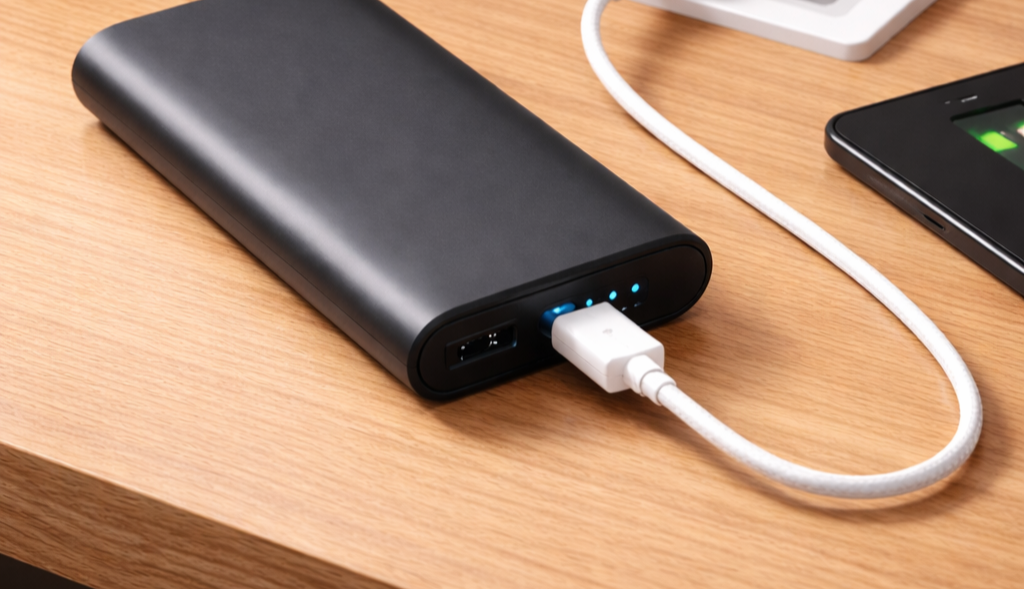
A power bank’s charging time depends on two things: its capacity (mAh) and its input wattage (W). A 10,000mAh power bank takes 3–6 hours with a modern charger, while a 20,000mAh unit takes 5–10 hours. The single biggest factor is whether your power bank supports fast charging protocols like USB-C Power Delivery (PD) or Qualcomm Quick Charge (QC) — and whether you’re actually using a compatible charger. This article breaks down the exact charging times for every common capacity, shows you how to calculate your own, and explains what’s slowing your power bank down.
Quick Answer
- 5,000mAh: 1.5–3 hours
- 10,000mAh: 3–6 hours
- 20,000mAh: 5–10 hours
- 30,000mAh: 7–12 hours
- Use a USB-C PD or QC charger matching your power bank’s max input wattage for the fastest charge
- A 5V/1A charger (the old USB-A style) can more than double these times
The Formula: Calculate Your Exact Charging Time
You don’t need to guess. There’s a straightforward formula:
Charging Time (hours) = Power Bank Capacity (mAh) ÷ Charger Output (mA) × 1.2
The 1.2 multiplier accounts for energy losses from heat dissipation, voltage conversion, and circuit inefficiencies. Lithium-ion batteries typically operate at 85–90% charging efficiency, so 1.2 is a conservative but realistic estimate.
Example Calculations
10,000mAh power bank with a 5V/2A (10W) charger: 10,000 ÷ 2,000 × 1.2 = 6 hours
10,000mAh power bank with an 18W PD charger (9V/2A): Here, the power bank’s internal circuitry converts the input. At 18W effective input, the math shifts to watt-hours. A 10,000mAh battery at 3.7V nominal = 37Wh. At 18W input with ~85% efficiency: 37 ÷ (18 × 0.85) = ~2.4 hours
20,000mAh power bank with a 20W PD charger: 74Wh ÷ (20 × 0.85) = ~4.4 hours
20,000mAh power bank with a 5V/1A (5W) charger: 20,000 ÷ 1,000 × 1.2 = 24 hours — not a typo.
The charger you use matters enormously. A 20W adapter charges a 20,000mAh power bank roughly 5× faster than a 5W adapter.
Charging Times by Capacity and Charger Type
| Power Bank Capacity | 5V/1A (5W) | 5V/2A (10W) | 18W (QC/PD) | 20–25W (PD) |
|---|---|---|---|---|
| 5,000mAh | ~7 hrs | ~3.5 hrs | ~1.5 hrs | ~1.2 hrs |
| 10,000mAh | ~14 hrs | ~6 hrs | ~2.5 hrs | ~2.2 hrs |
| 20,000mAh | ~28 hrs | ~12 hrs | ~5 hrs | ~4.5 hrs |
| 26,800mAh | ~37 hrs | ~16 hrs | ~7 hrs | ~6 hrs |
| 30,000mAh | ~42 hrs | ~18 hrs | ~8 hrs | ~7 hrs |
Times are estimates based on the formula above with a 1.2 inefficiency factor. Actual times vary by model, temperature, cable quality, and battery management system.
The key takeaway: if you’re still using the old 5V/1A charger that came with a phone five years ago, upgrading to a 20W USB-C PD adapter is the single most impactful thing you can do.
What Affects Power Bank Charging Speed
Input Wattage (The Biggest Factor)
The input wattage is how much power your power bank can accept. This is not the same as output wattage, which is how fast it charges your phone. A power bank might advertise “65W” on the box, but that’s often the output. Check the specs for the input rating — this determines how fast the power bank itself recharges.
Common input ratings:
- 5W (5V/1A): Legacy micro-USB power banks. Very slow.
- 10W (5V/2A): Standard USB-A input. Acceptable for small capacities.
- 18W (9V/2A): Quick Charge or USB-C PD input. The sweet spot for most users.
- 20–25W: Modern USB-C PD input. Fast and increasingly standard.
- 45–65W+: High-end power banks designed for laptops. These recharge themselves quickly too.
Charger and Cable Quality
Your power bank can only charge as fast as its weakest link. A 25W-capable power bank paired with a cheap 5V/1A charger will charge at 5W. Similarly, a thin or damaged USB cable creates resistance that limits current flow, reducing effective charging speed even with a good adapter.
For optimal results, use the cable that came with your power bank or a certified USB-C cable rated for the wattage you need .
Battery Capacity
This one is simple: more mAh means more time. A 20,000mAh power bank has twice the capacity of a 10,000mAh unit, so it takes roughly twice as long to charge with the same charger. Not sure what mAh actually means? I break it down in detail.
Charging Protocol Support
Fast charging only works when both sides support it. Your power bank needs USB-C PD or QC input support, and your wall adapter needs to output the matching protocol. If either side doesn’t support fast charging, the connection defaults to the slower standard (usually 5V/1A or 5V/2A).
Power Delivery (PD) is the most versatile and widely supported fast charging protocol for power banks. Quick Charge (QC) is Qualcomm’s standard, common on older or Android-focused devices. Many modern power banks support both.
Temperature
Lithium-ion batteries charge optimally between 10°C and 30°C (50°F–86°F). Charging in extreme heat or cold triggers the battery management system (BMS) to throttle input power to protect the cells. This means charging your power bank in a hot car or freezing garage will take significantly longer — and can also degrade the battery over time.
Pass-Through Charging
If you charge a device from your power bank while the power bank itself is plugged in (pass-through charging), the power bank’s recharge time increases. The incoming power is split between recharging the internal battery and powering the connected device. Some power banks disable fast charging input during pass-through to manage heat.
How to Charge Your Power Bank Faster
Match the charger to the power bank’s max input. Check the specs for the maximum input wattage, and use a charger that delivers at least that amount. A power bank rated for 18W input won’t benefit from a 65W charger — but it will charge slowly with a 5W charger.
Use a quality USB-C cable. A cable rated for 3A or higher is necessary for fast charging. Many bundled cables are fine; cheap gas-station cables are not.
Don’t charge and discharge simultaneously. Avoid pass-through charging when you’re in a hurry to recharge the power bank.
Keep it cool. Charge at room temperature. Remove it from cases or bags that trap heat.
Plug into a wall outlet. Charging from a laptop USB port or car charger is typically slower than a dedicated wall adapter because these sources often output less power.
Common Mistakes
Assuming the box wattage is input wattage. A power bank labeled “65W” usually means 65W output. The input could be 18W or 25W. Always check the fine print.
Plugging into the micro-USB port instead of USB-C. Some power banks have both ports but only support fast charging on one. USB-C is almost always the fast input port.
Blaming the power bank when the charger is the bottleneck. If your 20,000mAh power bank takes 12+ hours to charge, the problem is almost certainly your charger, not the power bank.
Thinking the first charge needs to be special. Modern lithium-ion batteries don’t require a conditioning first charge. The old advice of “charge it for 8 hours before first use” comes from nickel-cadmium batteries, which haven’t been used in power banks for decades. Charge it normally, use it normally.
Leaving it discharged for months. Lithium-ion cells degrade faster when stored at very low charge levels. If you’re storing a power bank long-term, charge it to about 50% and top it off every few months.
Frequently Asked Questions
Can I use a laptop charger to charge my power bank?
Yes, if the power bank has a USB-C input that supports PD. Many laptop chargers output 45W–65W over USB-C, which will charge your power bank at its maximum supported input rate. The power bank’s circuitry will only draw what it’s rated for, so there’s no risk of overloading it.
Why does my power bank slow down at 80%?
This is by design. The battery management system reduces charging speed as the battery approaches full capacity to protect cell health and prevent overcharging. This final 20% can take disproportionately longer than the first 80%.
Is it bad to charge my power bank overnight?
Modern power banks have overcharge protection circuits that stop drawing power at 100%. Overnight charging is safe for the vast majority of units. That said, unplugging when full is marginally better for long-term battery health.
Does a bigger power bank always take longer to charge?
Generally yes, if you use the same charger. But a 20,000mAh power bank with a 25W input will charge faster than a 10,000mAh power bank with a 5W input. Input wattage matters more than capacity for determining absolute charging time.
How do I know my power bank is fully charged?
Most power banks indicate charge status through LED lights (all solid = full) or a digital percentage display. Some models turn off the LED indicator when fully charged.
Summary
Power bank charging time comes down to a simple ratio: capacity divided by input power. A 10,000mAh power bank with a 20W PD charger takes about 2–3 hours; the same power bank with a 5W charger takes 12+ hours. Check your power bank’s input spec, match it with an appropriate wall adapter, use a quality USB-C cable, and charge at room temperature. That’s all there is to it.
Need help choosing?
Take the quiz