Charge Phone Overnight with Power Bank: Safe?
March 17, 2026
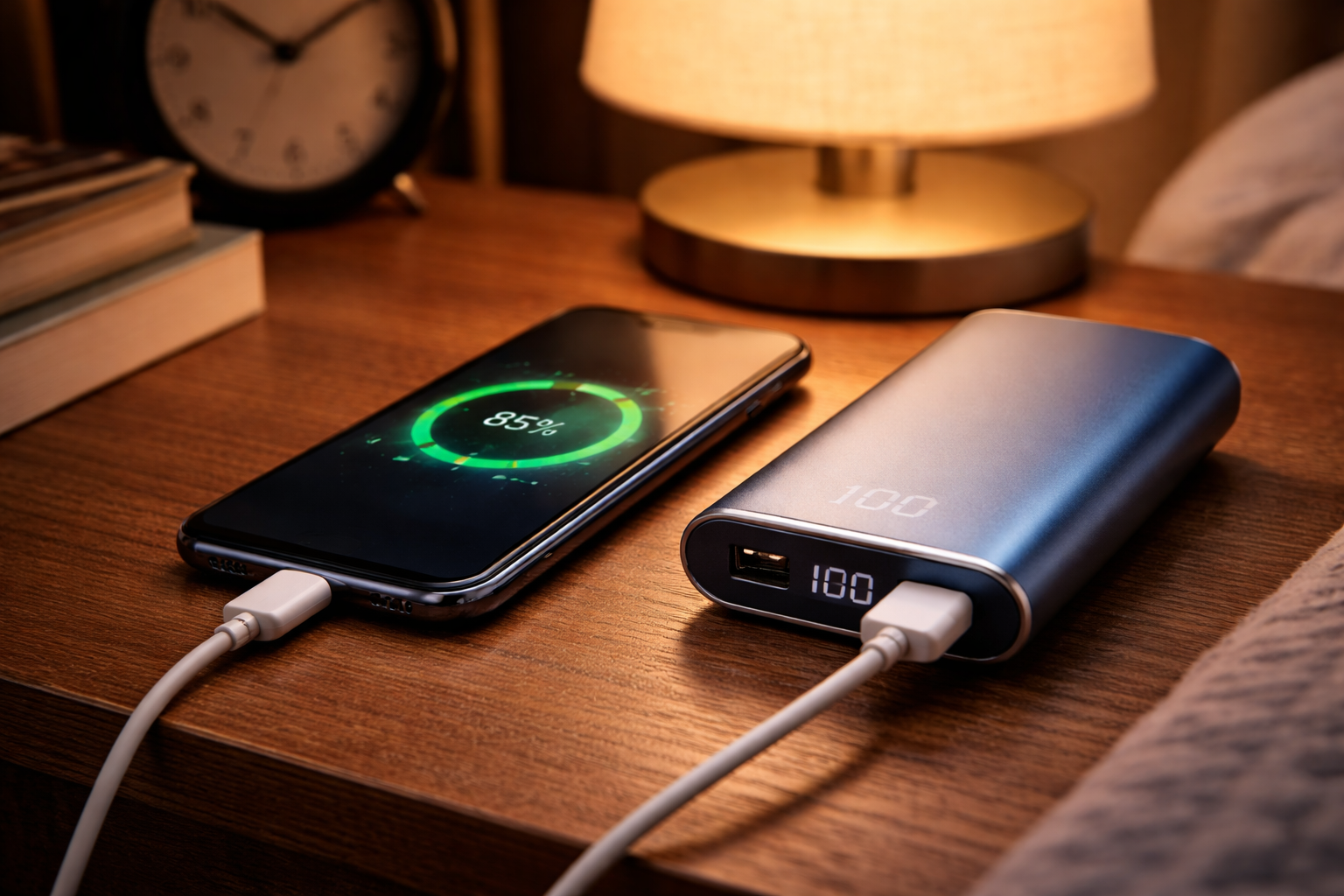
Charging your phone overnight with a power bank is generally safe — but only under specific conditions. Modern smartphones stop drawing current once they hit 100%, and quality power banks automatically shut off output when the phone is full. The real risks are not overcharging in the traditional sense. They are heat buildup from poor placement, slow battery degradation from extended time at full charge, and — most critically — power banks that lack the protection circuits to handle these situations correctly.
Quick Answer
- Modern phones and quality power banks both have overcharge protection — neither will keep forcing current once the phone is full
- The main risks are heat accumulation and long-term battery wear, not immediate device damage
- Uncertified or low-quality power banks may lack these protections entirely
- Safe placement (hard, ventilated surface) and a certified power bank eliminate most of the risk
What Actually Happens When You Charge Overnight
The Phone Side
Lithium-ion and lithium-polymer batteries — the type in every modern smartphone — include a Battery Management System (BMS). Once the phone reaches 100%, the BMS stops the charge flow. The phone then holds at full charge, drawing tiny “trickle” bursts of current to compensate for natural self-discharge.
This means the phone is not continuously pulling power all night. The charging hardware inside the phone manages this automatically, regardless of what is connected on the other end.
The Power Bank Side
A quality power bank monitors its output and cuts it off when the connected device is full. This is called auto-shutoff or output protection. Once the phone stops drawing significant current, the power bank registers the drop and turns off its output port.
The critical word is “quality.” Budget power banks — particularly uncertified ones — sometimes skip this circuit. They may continue pushing a low-level current indefinitely, generating heat and wearing both batteries faster.
Where the Risk Actually Lives
The combination of a certified phone and a certified power bank creates two layers of protection. But three real risks remain:
1. Heat accumulation. Charging generates heat. If a power bank is charging a phone while sitting under a pillow, inside a bag, or on a thick blanket, that heat has nowhere to go. In extreme cases with low-quality units, trapped heat can trigger thermal runaway — a chain reaction where rising temperature accelerates chemical breakdown, potentially causing swelling or fire.
2. Long-term battery degradation. Lithium batteries age fastest when held at 100% charge for extended periods. A phone sitting at full charge all night, every night, will see measurably faster capacity loss over 12–24 months compared to one unplugged at 80–90%. The same applies to the power bank’s own cells. A 10,000mAh power bank consistently kept at max charge may effectively deliver closer to 7,000–8,000mAh after a year.
3. Uncertified hardware. Power banks without UL, CE, FCC, or RoHS certification have not been independently tested for overcharge protection, short-circuit prevention, or thermal management. These are the units responsible for documented fire incidents reported by the U.S. Consumer Product Safety Commission (CPSC). In 2024, a power bank manufacturing defect — traced to a battery cell subcontractor replacing a critical separator material — triggered recalls from multiple major brands and an in-flight fire incident. Certification is not a formality.
How to Know if Your Power Bank Has Proper Protection
Check for these four features, either on the packaging, in the manual, or on the manufacturer’s product page:
| Feature | What It Does |
|---|---|
| Overcharge protection | Stops charging the power bank’s own cells past safe capacity |
| Over-discharge protection | Prevents the cells from draining below safe minimum voltage |
| Short-circuit protection | Cuts output if a fault is detected in the connected cable or device |
| Over-temperature protection | Reduces or stops output if internal temperature exceeds safe limits |
If a power bank’s listing does not mention any of these, assume they are absent.
Certification marks to look for: UL (US), CE (Europe), FCC (US radio frequency compliance), RoHS (restricts hazardous materials). These indicate independent testing, not just manufacturer claims.
Does Overnight Charging Damage the Power Bank Itself?
The power bank’s own battery is more exposed to degradation risk than the phone during overnight charging. When a power bank is actively pushing current to a phone, it is discharging. Once the phone is full and auto-shutoff triggers, the power bank sits idle. If it is also connected to a wall charger, it may begin recharging itself — a process called pass-through charging.
Pass-through charging (simultaneous input and output) is inefficient and generates more heat than normal charging. Most manufacturers advise against it for exactly this reason. Overnight, with a phone connected and a wall adapter also plugged in, both the phone and power bank can end up in a thermally stressed state.
The safest approach: charge the power bank separately, then use it to charge the phone overnight without the wall adapter connected.
Safe Practices for Overnight Charging
Surface matters. Place the power bank and phone on a hard, non-flammable surface — a wooden desk, tile floor, or bedside table. Never charge on a bed, sofa, or under bedding. Soft surfaces trap heat.
Temperature range. Lithium batteries charge most safely between 10°C and 30°C (50°F–86°F). Avoid charging in hot rooms or in direct sun exposure.
Inspect regularly. A power bank that is swollen, cracked, or runs unusually hot during normal use should not be used. Swelling indicates internal gas buildup from cell breakdown. This is not a cosmetic issue — it is a safety signal.
Check cable condition. Frayed or damaged cables increase short-circuit risk, especially at the connector junction. Replace cables showing visible wear.
Avoid daisy-chaining. Charging your phone through a power bank while that power bank is simultaneously charging from a wall adapter compounds heat generation and accelerates cell wear on both devices.
Common Mistakes
Assuming all power banks are equivalent. A $9 power bank from an unverified seller and a certified unit from an established brand have fundamentally different internal components. The difference is not just build quality — it is the presence or absence of the protection circuits that make overnight charging safe.
Placing devices under pillows. This is the most consistent factor in documented power bank fire incidents. Fabric insulates heat. Even a certified power bank can overheat in a poorly ventilated environment.
Ignoring swelling. A puffed battery is already failing. Continuing to use a swollen power bank — especially overnight — is high risk. Dispose of lithium batteries at a certified recycling facility, not in regular waste.
Charging at 0% regularly. Deep discharges below 10–15% accelerate cell degradation in lithium batteries. Recharging a power bank when it drops to 20–30% extends its overall lifespan.
Frequently Asked Questions
Will charging my phone with a power bank overnight damage the phone battery?
Not significantly, provided both devices are quality products with proper protection circuits. The phone stops accepting charge at 100%. The main long-term effect is marginal degradation from extended time at full charge — measurable over years, not nights.
Can a power bank catch fire while charging a phone overnight?
With certified hardware on a hard, ventilated surface, the risk is extremely low. The documented fire incidents almost universally involve uncertified power banks, physical damage, or blocked ventilation. Thermal runaway requires a combination of factors — it does not happen spontaneously in properly functioning units.
Is it okay to leave a power bank plugged into the wall and phone at the same time overnight?
This is pass-through charging and is not recommended for overnight use. It generates excess heat and accelerates battery wear in both devices. Charge the power bank separately first.
How do I know if my power bank has auto-shutoff?
Check the product manual or manufacturer’s website for mention of “auto-shutoff,” “output protection,” or the four protection features listed above. If this information is not available, the feature may not be present.
Does overnight charging reduce power bank capacity over time?
Yes, gradually. Lithium cells held at maximum charge consistently degrade faster than those cycled between 20–80%. The effect is cumulative over months and years, not immediate.
Summary
Overnight phone charging with a power bank is safe when using certified hardware on a hard, ventilated surface with no simultaneous wall charging. The risks — heat accumulation, gradual battery wear, and uncertified hardware failure — are real but preventable. The protection circuits in quality power banks and modern smartphones handle the actual overcharge concern. Placement and product certification are where the meaningful safety decisions happen.
Need help choosing?
Take the quiz