Can a Power Bank Explode? Safety Facts
March 10, 2026
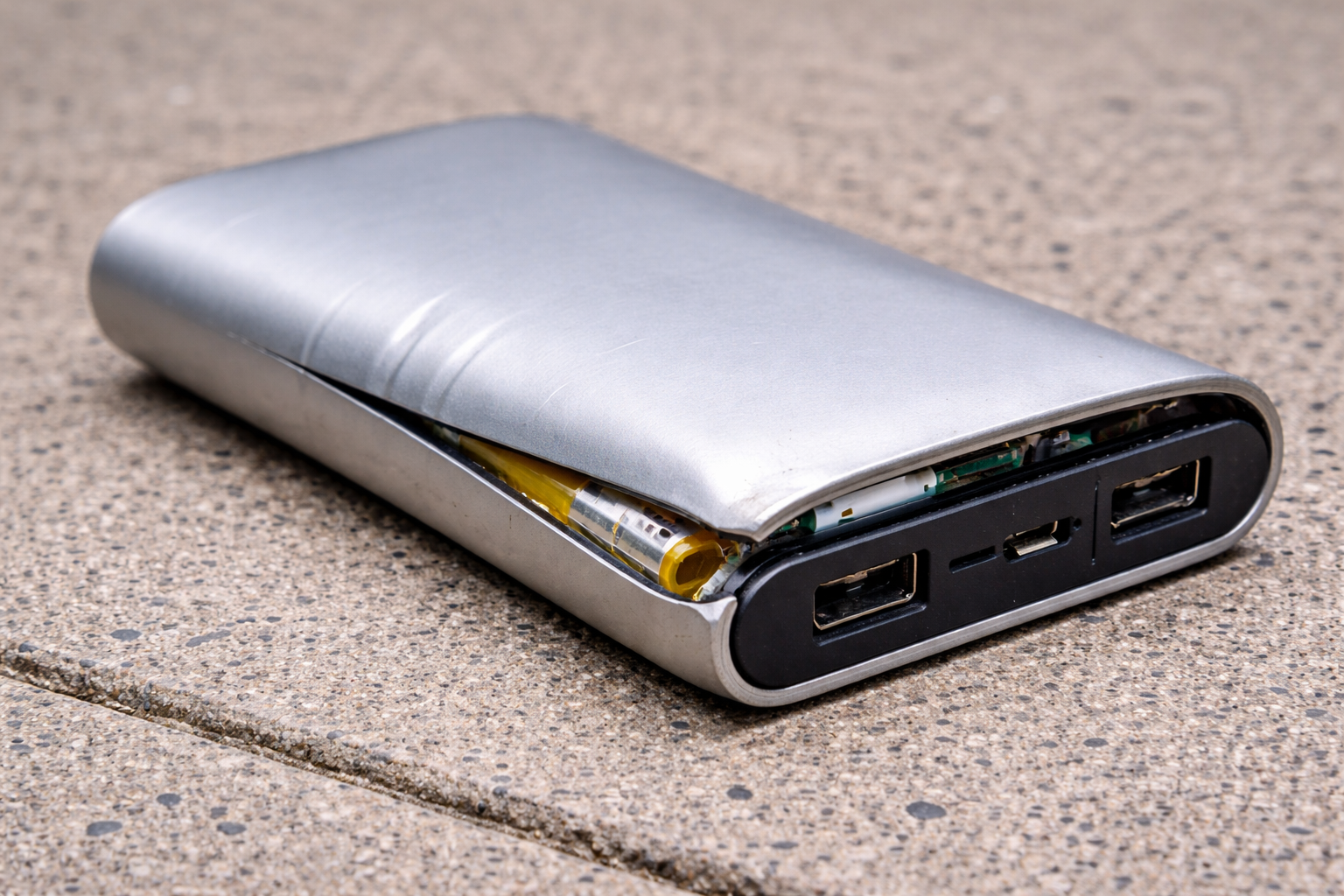
Power banks can catch fire or, in rare cases, explode — but the risk is lower than media coverage suggests. The failure rate for lithium-ion batteries is fewer than 1 in 1,000,000 units, according to EPA data. When failures do occur, they almost always result from a specific chain of events: thermal runaway triggered by physical damage, manufacturing defects, or misuse. Understanding what actually causes these incidents makes them largely preventable.
Quick Answer
- Power banks use lithium-ion or lithium-polymer batteries, both of which can enter thermal runaway — an uncontrollable heating cycle — under certain conditions.
- The three main triggers are physical damage, manufacturing defects, and improper charging habits.
- Warning signs include swelling, unusual heat, chemical smell, and leaking fluid.
- Certified power banks with proper PCB protection circuits are significantly safer than uncertified alternatives.
What Actually Happens During a Power Bank “Explosion”
The word explosion is technically imprecise in most cases. What actually occurs is called thermal runaway — a self-accelerating chemical reaction inside the battery cell that produces intense heat, flammable gas, and sometimes fire.
The Internal Structure of a Lithium Battery
A lithium-ion battery cell has three core components: an anode (negative), a cathode (positive), and a thin separator film between them, all submerged in a flammable liquid electrolyte. During normal charging, lithium ions pass through the electrolyte from one side to the other. The separator keeps the two sides from touching.
When the separator is breached — through physical damage, manufacturing error, or extreme heat — the anode and cathode connect directly. This short circuit generates rapid heat, which vaporizes the electrolyte. That vapor is flammable. If pressure builds faster than the casing can vent it, the result is a rupture — which looks and sounds like an explosion.
Lithium-Ion vs. Lithium-Polymer Cells
Most power banks use one of two cell types:
| Cell Type | Format | Electrolyte | Failure Behavior |
|---|---|---|---|
| Lithium-ion (18650) | Cylindrical | Liquid | Can rupture violently if pressure builds |
| Lithium-polymer (LiPo) | Flat/pouch | Gel or solid | Burns slowly, less likely to rupture |
Lithium-polymer cells are generally considered safer because the gel electrolyte doesn’t vaporize as aggressively. If they fail, they tend to swell and burn rather than explode. Higher-quality power banks increasingly use lithium-polymer cells for this reason.
The Five Root Causes of Power Bank Fires
1. Physical Damage
Dropping, crushing, or puncturing a power bank can tear the internal separator — the single layer preventing a direct short circuit between anode and cathode. Even damage that isn’t immediately visible can create mechanical stress that leads to failure hours or days later. A power bank that has been dropped hard should be treated as suspect and not charged unattended.
2. Manufacturing Defects
This is the most common cause behind mass recalls. In 2024, a ROMOSS 20,000mAh power bank caught fire on a Hong Kong Airlines flight, triggering a voluntary recall of nearly 500,000 units. Investigations traced the issue to battery cells from a major lithium battery supplier. Manufacturing defects typically involve microscopic contamination between cell layers — a dust particle, a separator wrinkle, or an inconsistent weld — that creates a localized weak point.
In June 2024, the U.S. Consumer Product Safety Commission also warned that 132,000 Baseus Magnetic Wireless Charging Power Banks posed fire and overheating risks, linked to 39 fires and 13 burn injuries.
Certifications like UL 62133 and UN 38.3 reduce this risk by requiring batch testing, but they cannot eliminate it entirely — they test samples, not every unit produced.
3. Overheating During Charging
Charging a power bank on a heat-retaining surface — like fabric, a bag, or a bed — traps heat around the unit. This raises internal temperature, increasing the risk of thermal runaway, particularly during fast charging cycles. Aluminum or hard plastic surfaces that allow airflow are significantly safer.
4. Overcharging and Over-Discharging
Prolonged overcharging or over-discharging stresses the battery, destabilizing chemical reactions and causing swelling or leaks. Over-discharging also reduces battery capacity and can cause structural damage — increasing failure risk during subsequent charging cycles. Quality power banks include PCB circuits with overcharge cutoffs, but cheap units may omit or underbuild these protections.
5. Poor-Quality or Counterfeit Components
Budget power banks frequently use low-grade 18650 cells or counterfeit cells marketed under reputable brand names. Low-cost manufacturers may use defective or recycled cells without rigorous testing, which greatly increases the risk of failure. The PCB circuit board — which controls charge flow, monitors temperature, and cuts power in fault conditions — is also often simplified or omitted in counterfeit units.
Warning Signs to Watch For
Thermal runaway rarely occurs without prior warning. These signs indicate a power bank should be removed from use immediately:
Swelling or bulging — the most reliable indicator of internal pressure buildup. A swollen power bank is no longer safe to charge or carry.
Unusual heat — power banks warm during charging and discharging, but should never be too hot to hold comfortably. Excessive heat during idle periods is a serious warning sign.
Chemical or burning smell — vaporizing electrolyte produces a distinctive sharp chemical odor before ignition.
Leaking fluid — the electrolyte is toxic. Handle with care and dispose of immediately at a battery recycling facility.
Hissing or crackling sounds — gas venting from inside the cell.
What to Do If a Power Bank Catches Fire
If a power bank is smoking or has caught fire, evacuate the area immediately and call emergency services. Lithium-ion batteries burn quickly and release toxic, flammable fumes. Even if the fire appears to go out, the battery may reignite — do not assume it is safe.
Do not use water as the first response on an active lithium fire in an enclosed space, as it can spread burning electrolyte. The FAA recommends directing water onto the battery to cool it and prevent thermal runaway from spreading to adjacent cells. Never smother a lithium fire with a blanket, as this traps heat.
How to Minimize Risk
Charge on hard, flat surfaces. Hard surfaces dissipate heat and prevent the power bank from being enclosed in insulating material.
Avoid charging overnight or unattended. Most incidents occur when no one is present to notice early warning signs.
Inspect before use. Check for swelling, dents, or damage before each charging cycle, especially if the unit has been dropped.
Use certified products. Look for UL 62133, CE, or UN 38.3 certification. These confirm the design passed standardized safety testing.
Store at partial charge. For long-term storage, 40–60% charge is the optimal range for lithium cell stability. Full charge or deep discharge both accelerate cell degradation.
Avoid extreme temperatures. Both high heat and extreme cold degrade lithium cells. Do not leave power banks in hot cars or direct sunlight.
Common Mistakes
Assuming size equals safety. A 20,000mAh power bank contains more total energy than a 5,000mAh unit, which means a failure event releases more heat. Capacity alone does not determine safety — cell quality and PCB protection do.
Ignoring minor swelling. A slightly puffy power bank is not a minor cosmetic issue. It signals active chemical failure inside the cell. Many fire incidents began with swelling that was dismissed.
Assuming brand names guarantee safety. The 2024 recalls demonstrate that even established brands can ship defective units when a supplier’s cell batch is compromised. Checking CPSC recall databases periodically is worthwhile for any power bank purchased online.
Using non-original charging cables. Cables without proper resistance ratings can pass incorrect voltage or current to the power bank’s input circuit, bypassing its designed operating range.
Frequently Asked Questions
Can a power bank explode in my bag?
Yes, though it is rare. Physical pressure from items packed tightly around the power bank, combined with residual heat, can trigger failure. Aviation authorities specifically require power banks to be carried in carry-on luggage — not checked baggage — so any fire can be quickly identified and contained.
Is it safe to charge a power bank overnight?
Quality power banks with overcharge protection circuits will stop drawing current at 100%. However, leaving any lithium device charging overnight on a fabric surface (bedding, couch) increases thermal risk. Charging on a hard surface and unplugging when complete is the safer practice.
How do I know if my power bank is certified?
Look for UL 62133, CE, or UN 38.3 markings on the unit or packaging. The CPSC recall database (cpsc.gov) lists products with known safety issues. Avoid units with no certification markings or unusually high capacity claims relative to their physical size and weight.
What should I do with a swollen power bank?
Stop using it immediately. Do not attempt to puncture or compress it. Place it in a fireproof container if available, and transport it to a certified battery recycling facility. Many electronics retailers accept lithium battery drop-offs.
Do lithium-polymer power banks explode?
Lithium-polymer cells are less prone to violent rupture than cylindrical lithium-ion cells because their gel electrolyte vaporizes less aggressively. They can still catch fire during thermal runaway, but the failure mode is typically slower and produces less pressure buildup.
Summary
Power bank fires are rare but real, and they follow a predictable pattern: damaged cells, poor manufacturing, or heat accumulation trigger thermal runaway, which escalates rapidly once started. The failure rate is approximately 1 in 1,000,000 battery cells, but that probability shifts significantly with physical damage, counterfeit components, or improper charging habits. Recognizing early warning signs — swelling, unusual heat, chemical odor — and following basic charging practices eliminates the majority of preventable risk.
Need help choosing?
Take the quiz