Can a Power Bank Charge a Nintendo Switch or Steam Deck?
April 07, 2026
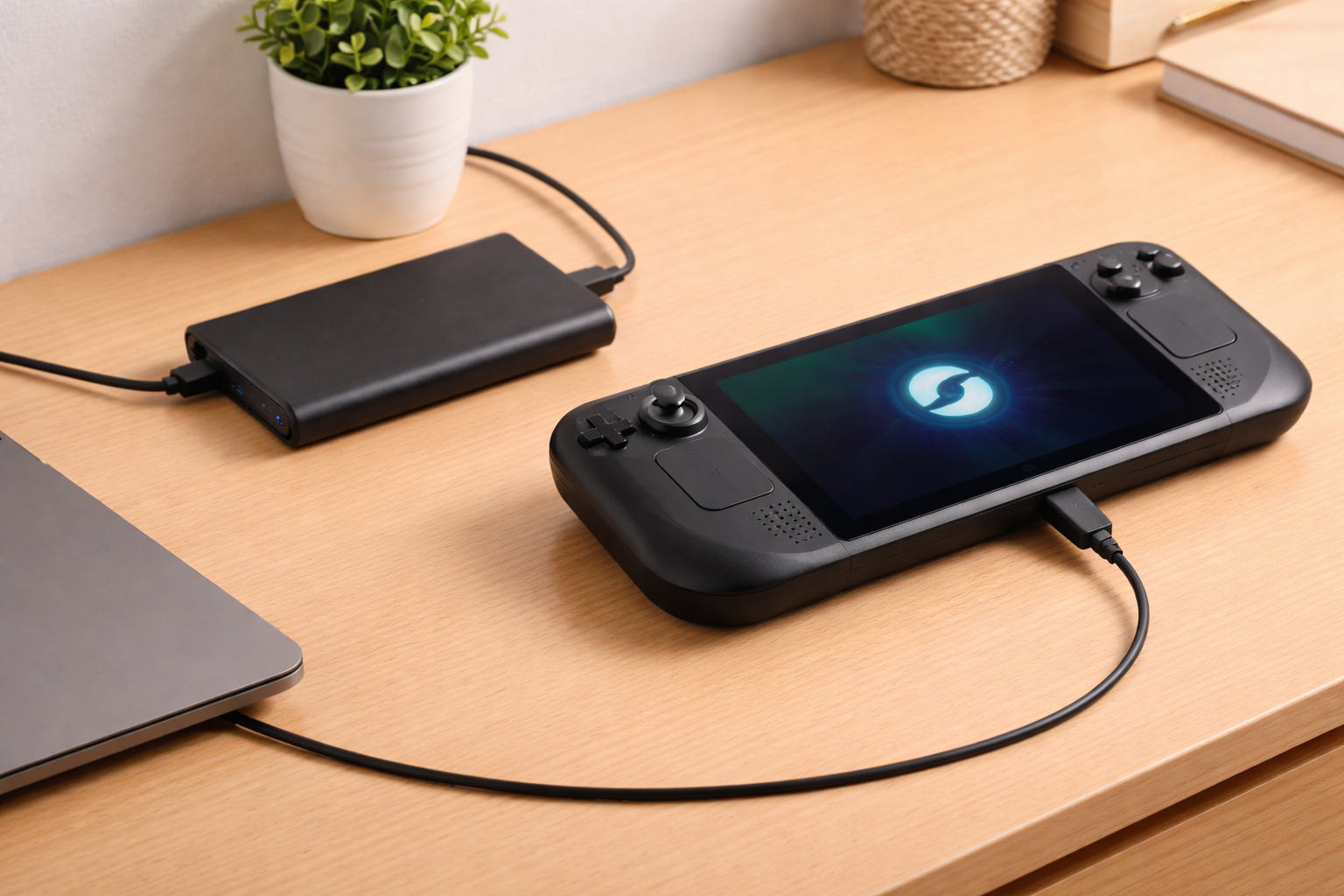
Yes, a power bank can charge both the Nintendo Switch and Steam Deck — both use USB-C with Power Delivery (PD) support. The difference is in how demanding each device is. The Nintendo Switch draws a maximum of 18W and works with almost any USB-C PD power bank. The Steam Deck draws up to 45W and requires a power bank that specifically supports USB-C PD 3.0 at that wattage to charge while actively gaming. A lower-output power bank will still charge a Steam Deck, but only slowly and only when the device is in sleep or low-load mode.
Quick Answer
- Nintendo Switch (original/OLED): Any USB-C PD power bank works. Max draw is 18W. Even a standard 10W USB-C output charges the device, just more slowly.
- Nintendo Switch Lite: Same compatibility. Max draw is 13.5W.
- Steam Deck (LCD/OLED): Requires USB-C PD 3.0. Needs at least 45W output to charge during gameplay. A 30W bank charges in sleep mode; below 15W the battery drains faster than it charges.
- Cable matters: Use a USB-C to USB-C cable rated for at least the wattage you need. A cheap cable rated for 5W will cap charging speed regardless of the power bank.
Nintendo Switch: Power Requirements and What Works
How Much Power the Switch Actually Draws
The Nintendo Switch uses USB-C with Power Delivery. In handheld mode, the original Switch and Switch OLED draw a maximum of 18W — specifically 15V at 1.2A under the PD protocol. The Switch Lite draws up to 13.5W.
These numbers are lower than many assume. The included Nintendo AC adapter outputs up to 39W, but the Switch console itself never accepts more than 18W. This means the adapter is oversized by design, mostly to meet the power requirements of the dock (which needs 39W to power the TV output and USB ports simultaneously).
A standard USB-C power bank without PD support will deliver 5V at 2A (10W) to the Switch. This is enough to charge the device while gaming in all but the most demanding scenarios.
Will the Switch Drain Faster Than It Charges?
Under maximum gaming load, the Switch draws roughly 8–9W from the battery. With a 10W USB-C source, the device charges at a net rate of approximately 1–2W — slow, but the battery level increases rather than decreases.
With USB-C PD at 18W, the Switch charges significantly faster. A 10,000mAh power bank with 18W PD output can fully charge a depleted Switch (4,310mAh battery) approximately 1.3 times, accounting for typical conversion losses of 35–40%.
Estimated Charges Per Power Bank Capacity
The Switch battery is 4,310mAh (original and OLED models). Usable energy from a power bank is typically 60–65% of rated capacity due to voltage conversion losses.
| Power Bank Capacity | Usable Energy | Full Switch Charges (approx.) |
|---|---|---|
| 10,000mAh | ~6,000mAh | ~1.4 |
| 20,000mAh | ~12,000mAh | ~2.8 |
| 26,800mAh | ~16,000mAh | ~3.7 |
Steam Deck: A Higher Bar
Why the Steam Deck Demands More
The Steam Deck is a full PC in handheld form. Its AMD APU alone draws up to 15W, and when combined with the display, RAM, SSD, Wi-Fi, and cooling system, total system power draw during demanding games lands in the 20–27W range. The device ships with a 45W USB-C PD 3.0 charger for this reason.
If a connected power bank cannot supply enough watts to cover the system draw, the device will continue pulling from its internal battery even while plugged in. Below roughly 15W input, the battery drains despite being connected. Between 15W and 45W, the battery may maintain level or charge slowly depending on the workload.
For charging while gaming at full intensity, 45W USB-C PD 3.0 is required. For charging during light games or sleep, 30W is sufficient.
What Happens Without PD 3.0
If a power bank only supports basic USB-C (5V/3A = 15W) without the PD protocol, the Steam Deck falls back to a low-power charging mode drawing only around 10W. This is enough to slowly top up a powered-off device, but it will not keep pace with power consumption during gameplay.
The PD protocol allows the Steam Deck to negotiate a higher voltage (typically 15V or 20V) with the charger, enabling the full 45W transfer. Without that negotiation, the device is limited to the default 5V rail.
Estimated Charges Per Power Bank Capacity
The Steam Deck LCD has a 40Wh battery; the OLED model has a 50Wh battery. Power banks are rated in mAh at 3.7V, which converts to Wh differently depending on the bank.
| Power Bank | Approx. Wh | Steam Deck LCD Charges | Steam Deck OLED Charges |
|---|---|---|---|
| 20,000mAh (~74Wh) | ~44Wh usable | ~1.1 | ~0.9 |
| 26,800mAh (~99Wh) | ~59Wh usable | ~1.5 | ~1.2 |
For gaming on the go, a 26,800mAh (99Wh) power bank offers the best balance — it falls just under the 100Wh airline carry-on limit while providing more than one full Steam Deck charge.
Charging Both Devices Simultaneously
A power bank with multiple USB-C PD ports can charge both devices at the same time, but there are important caveats. Most power banks share their total output budget across all ports. A bank rated at 65W total might allocate 45W to the USB-C port used for the Steam Deck and 18W to a second port — or it might split 45W each way depending on the hardware. Check the multi-port spec sheet, not just the headline wattage.
Some power banks reduce per-port output when multiple devices are connected. A bank that claims 65W on a single USB-C port might drop to 30W per port when both ports are in use.
Common Mistakes
Using a USB-A to USB-C adapter cable: USB-A chargers and power banks cannot negotiate PD voltages. The Switch will charge at a maximum of 7.5W from USB-A, and the Steam Deck will charge at 10W at best — often slower. Always use a USB-C to USB-C cable for best results.
Assuming any “fast charge” label means PD: Quick Charge (QC) is Qualcomm’s proprietary protocol, separate from USB-C PD. Some power banks advertise “fast charging” using QC over USB-A, which is irrelevant for the Switch or Steam Deck. Look specifically for USB-C PD ratings.
Ignoring the cable rating: A USB-C cable rated for 18W will throttle charging even if the power bank supports 45W. For Steam Deck charging, use a cable rated for at least 60W (5A). For the Switch, a standard USB-C cable rated for 3A/60W is sufficient.
Charging a docked Switch from a power bank: The Switch dock requires a full 39W at 15V to function correctly, including TV output. Most power banks that support 18W PD use the 9V or 12V rails, not the 15V rail the dock expects. The dock may not work, or may work intermittently.
Frequently Asked Questions
Can I use a phone charger power bank for the Nintendo Switch?
Yes. A standard 18W or 20W USB-C PD power bank — the same type used for fast-charging Android phones — works well for the Switch. The Switch will draw up to 18W from it, which covers all gaming scenarios without battery drain.
Will a low-wattage power bank damage the Steam Deck?
No. The Steam Deck negotiates power levels with the source via PD 3.0. A lower-wattage bank simply results in slower charging, not hardware damage.
Why does my Steam Deck still lose battery even when plugged into a power bank?
The power bank’s output wattage is too low to cover the system’s current draw. The Steam Deck needs at least 15W to maintain battery level during light gaming. Below that threshold, the device draws the shortfall from the internal battery.
Can I charge a Steam Deck from a laptop’s USB-C port?
It depends on whether the laptop’s USB-C port supports Power Delivery output and at what wattage. Many laptop USB-C ports support 15W PD output, which will slowly charge a powered-off Steam Deck. Some Thunderbolt or full-spec USB4 ports support higher output.
Is there a charge limit I should set for the power bank to protect battery health?
The Switch and Steam Deck include battery management circuits that prevent overcharging. The power bank itself will stop supplying power once the device reaches full charge. No special settings are required.
Summary
The Nintendo Switch is easy to charge from almost any USB-C power bank — its 18W ceiling makes it compatible with the widest range of portable chargers on the market. The Steam Deck is more demanding: it requires a USB-C PD 3.0 power bank rated at 45W or more to maintain full charge during active gameplay. For travel, a 26,800mAh bank (just under the 100Wh airline limit) covers both devices with capacity to spare.
Need help choosing?
Take the quiz