20,000mAh Power Bank: How Many Charges?
February 15, 2026
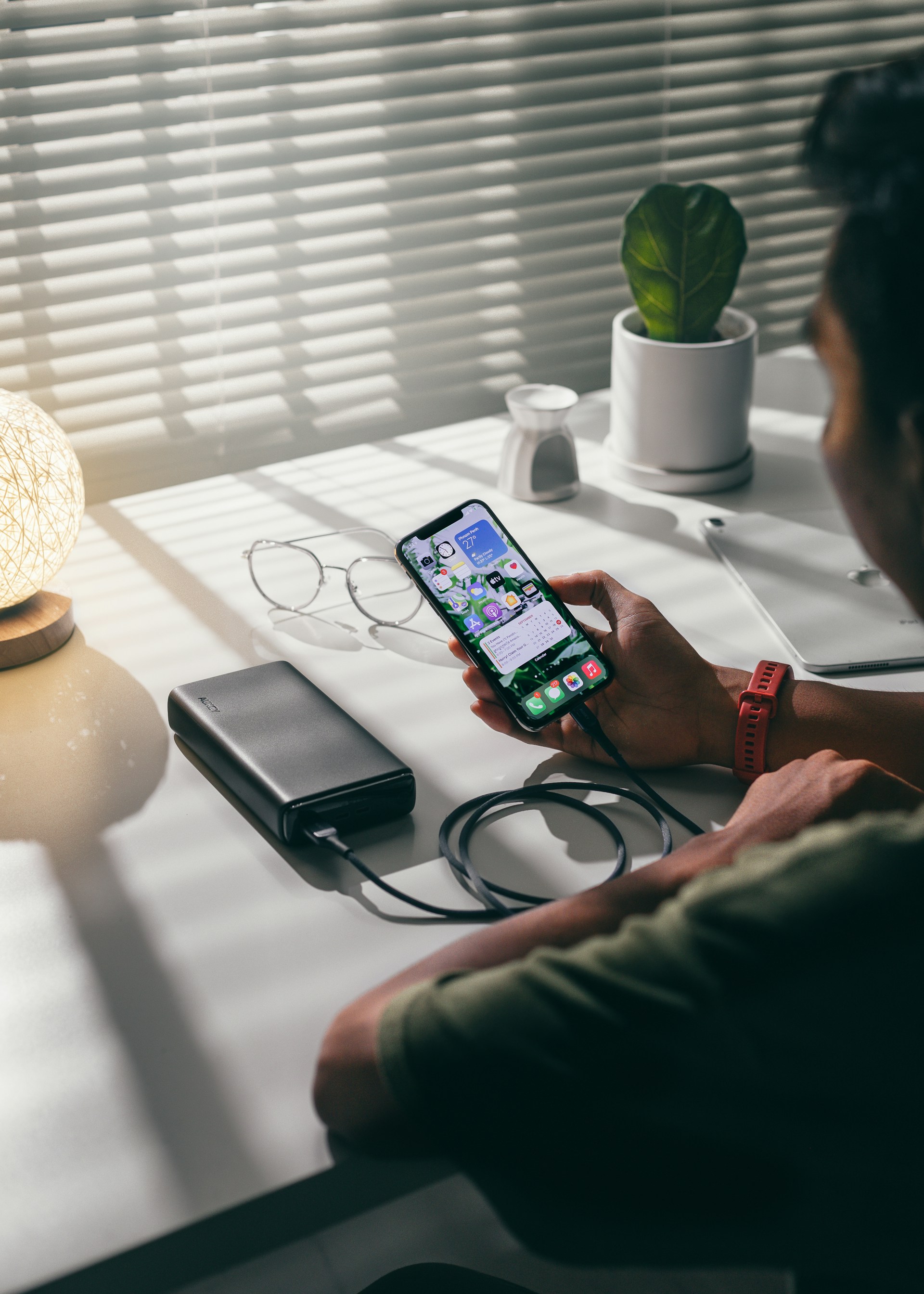
A 20000mAh power bank can charge most smartphones 3 to 4 times from 0% to 100%. The exact number depends on two factors: your phone’s battery capacity and the power bank’s energy conversion efficiency. A 20000mAh power bank doesn’t deliver the full 20000mAh to your phone — roughly 30–38% is lost to voltage conversion and heat. That leaves around 12,400–14,000mAh of usable capacity. Divide that by your phone’s battery size, and you get your answer.
This article breaks down the math for every major phone, explains why the rated capacity doesn’t match real-world performance, and shows how to calculate charge cycles for any device.
Quick Answer
- iPhone 16 (3,561mAh): 3.5–4 full charges
- Samsung Galaxy S25 (4,000mAh): 3–3.5 full charges
- iPhone 16 Pro Max (4,685mAh): 2.5–3 full charges
- Samsung Galaxy S25 Ultra (5,000mAh): 2.5–2.8 full charges
These numbers assume a quality power bank with 65–70% conversion efficiency.
The Math Behind 20000mAh
Why You Don’t Get the Full 20000mAh
The “20000mAh” rating on the label measures capacity at the battery cell’s internal voltage — typically 3.7V. Your phone charges at 5V (or higher with fast charging). Converting from 3.7V to 5V wastes energy as heat.
Here’s the formula:
Usable capacity = Rated capacity × (3.7V ÷ 5V) × Efficiency
For a 20000mAh power bank with 90% internal efficiency:
20,000 × 0.74 × 0.90 = 13,320mAh usable at 5V
This means roughly 13,000–14,000mAh actually reaches your phone. Budget power banks with lower efficiency may deliver as little as 12,000mAh.
How to Calculate Charges for Your Phone
Number of charges = Usable capacity ÷ Phone battery capacity
Example with iPhone 16: 13,320 ÷ 3,561 = 3.7 full charges
Example with Samsung Galaxy S25 Ultra: 13,320 ÷ 5,000 = 2.7 full charges
Charge Cycles for Popular Phones (2024–2025)
Here’s a reference table using 13,000mAh as a conservative usable estimate and 14,000mAh as an optimistic one.
| Phone | Battery Capacity | Charges (Conservative) | Charges (Optimistic) |
|---|---|---|---|
| iPhone 16 | 3,561mAh | 3.7 | 3.9 |
| iPhone 16 Plus | 4,006mAh | 3.2 | 3.5 |
| iPhone 16 Pro | 3,582mAh | 3.6 | 3.9 |
| iPhone 16 Pro Max | 4,685mAh | 2.8 | 3.0 |
| Samsung Galaxy S25 | 4,000mAh | 3.3 | 3.5 |
| Samsung Galaxy S25+ | 4,900mAh | 2.7 | 2.9 |
| Samsung Galaxy S25 Ultra | 5,000mAh | 2.6 | 2.8 |
| Google Pixel 9 | 4,700mAh | 2.8 | 3.0 |
| Google Pixel 9 Pro | 4,700mAh | 2.8 | 3.0 |
| Google Pixel 9 Pro XL | 5,060mAh | 2.6 | 2.8 |
Key takeaway: Standard-sized phones (3,500–4,000mAh) get 3–4 charges. Large phones and “Ultra” models (4,700–5,000mAh+) get closer to 2.5–3 charges.
What Affects the Actual Number of Charges
Conversion Efficiency
Not all 20000mAh power banks are equal. Conversion efficiency varies by brand and build quality:
- Premium brands (Anker, Ugreen, Baseus): 70–75% efficiency, delivering ~14,000mAh
- Mid-range brands: 65–70% efficiency, delivering ~13,000mAh
- Budget/no-name brands: 60–65% efficiency, delivering ~12,000mAh
This means the same “20000mAh” label can translate to a difference of 2,000mAh in usable power — enough for roughly half an extra phone charge.
Charging Speed and Protocol
Fast charging generates more heat, which reduces efficiency slightly. A power bank charging a phone at 65W (via USB-C PD) will deliver marginally fewer total charges than one charging at 10W. The difference is small — typically 5–10% — but it exists.
PD (Power Delivery) is the USB-C fast charging protocol that negotiates the optimal voltage and current between the power bank and your device. QC (Quick Charge) is Qualcomm’s equivalent for many Android phones. Both increase charging speed but produce slightly more heat than standard 5V/2A charging.
Cable Quality
A cheap or damaged cable adds resistance, which wastes energy as heat. Use the cable that came with your phone or a certified USB-IF cable. Frayed or excessively long cables (over 1 meter) can reduce delivered power noticeably.
Temperature
Lithium-ion batteries perform best between 20–25°C (68–77°F). Charging in extreme heat (above 35°C) or cold (below 5°C) reduces both efficiency and battery lifespan. Avoid leaving your power bank in a hot car or charging devices in direct sunlight.
Charging From 0% vs. Topping Off
Charging from 0% to 100% is less efficient than topping off from 50% to 100%. The last 20% of a charge cycle (80–100%) uses more energy due to how lithium-ion batteries regulate voltage at near-full capacity. In practice, most people top off rather than fully drain, so a 20000mAh power bank used for partial charges may provide more total charging sessions than the numbers above suggest.
20000mAh vs. Other Capacities
For context, here’s how a 20000mAh power bank compares to other common sizes, using the iPhone 16 (3,561mAh) as a reference:
| Power Bank Capacity | Usable mAh (est.) | iPhone 16 Charges |
|---|---|---|
| 5,000mAh | ~3,300mAh | ~0.9 |
| 10,000mAh | ~6,600mAh | ~1.9 |
| 20,000mAh | ~13,200mAh | ~3.7 |
| 26,800mAh | ~17,700mAh | ~5.0 |
A 20000mAh power bank hits the sweet spot for most users — enough for 3+ full charges of a standard phone while still being portable enough to carry daily. Larger capacities exist (26,800mAh is the maximum allowed on most airlines without special approval), but they’re heavier and often not worth the tradeoff.
Common Mistakes
Trusting the mAh number at face value. A 20000mAh power bank never delivers 20000mAh to your phone. Always factor in 30–38% conversion loss. If a brand claims 95%+ efficiency, be skeptical.
Comparing only mAh between power banks. Two 20000mAh power banks can deliver different usable capacity depending on cell quality and circuit design. Check reviews that measure actual output, not just the spec sheet.
Ignoring watt-hours (Wh). Some power banks list capacity in Wh instead of mAh. To convert: Wh = mAh × V ÷ 1000. A 20000mAh / 3.7V power bank = 74Wh. This is also the number airlines care about — most allow up to 100Wh in carry-on luggage.
Using the wrong cable. A USB-A to Micro-USB cable with a USB-C phone? You’re leaving charging speed (and some efficiency) on the table. Match your cable to your phone’s port and the power bank’s highest output port.
Frequently Asked Questions
Q: Can a 20000mAh power bank charge a laptop? A: Some can, if they support USB-C PD output at 45W or higher. Most laptops require 30–65W. A 20000mAh (74Wh) power bank can add roughly 50–70% charge to an ultrabook like a MacBook Air. Check that the power bank’s PD output wattage matches your laptop’s requirements.
Q: How long does it take to fully charge a 20000mAh power bank? A: With an 18W charger, expect 6–8 hours. With a 25–30W charger, around 4–5 hours. Some models with dual input can charge faster. Overnight charging is the most practical approach for most users.
Q: Does pass-through charging reduce the number of phone charges? A: Slightly. Pass-through charging (charging your phone while the power bank itself is charging) generates additional heat, reducing overall efficiency by approximately 5–10%. It’s convenient but not the most efficient way to use your power bank.
Q: How many charge cycles does a 20000mAh power bank last? A: Most quality power banks last 500+ charge cycles before capacity drops to 80% of original. This means if you charge and drain it completely once per week, it should last roughly 8–10 years before significant degradation. In practice, power banks last 3–5 years before other factors (cable wear, connector loosening, internal resistance) become issues.
Q: Is 20000mAh enough for a week-long trip? A: For phone-only use, a 20000mAh power bank provides 3–4 full charges. If you charge your phone once per day and use the power bank as a supplement (topping off from 30–40%), it can stretch to cover 5–7 days of travel. For heavier use or multiple devices, consider bringing two or a larger capacity model.
Summary
A 20000mAh power bank delivers approximately 13,000–14,000mAh of usable charging capacity after accounting for voltage conversion losses. For standard phones like the iPhone 16 or Samsung Galaxy S25, that translates to 3–4 full charges. Larger phones with 5,000mAh batteries get closer to 2.5–3 charges. The exact number depends on the power bank’s conversion efficiency, charging protocol, cable quality, and ambient temperature.
Need help choosing?
Take the quiz