18W vs 30W vs 65W: Charging Speed Explained
March 19, 2026
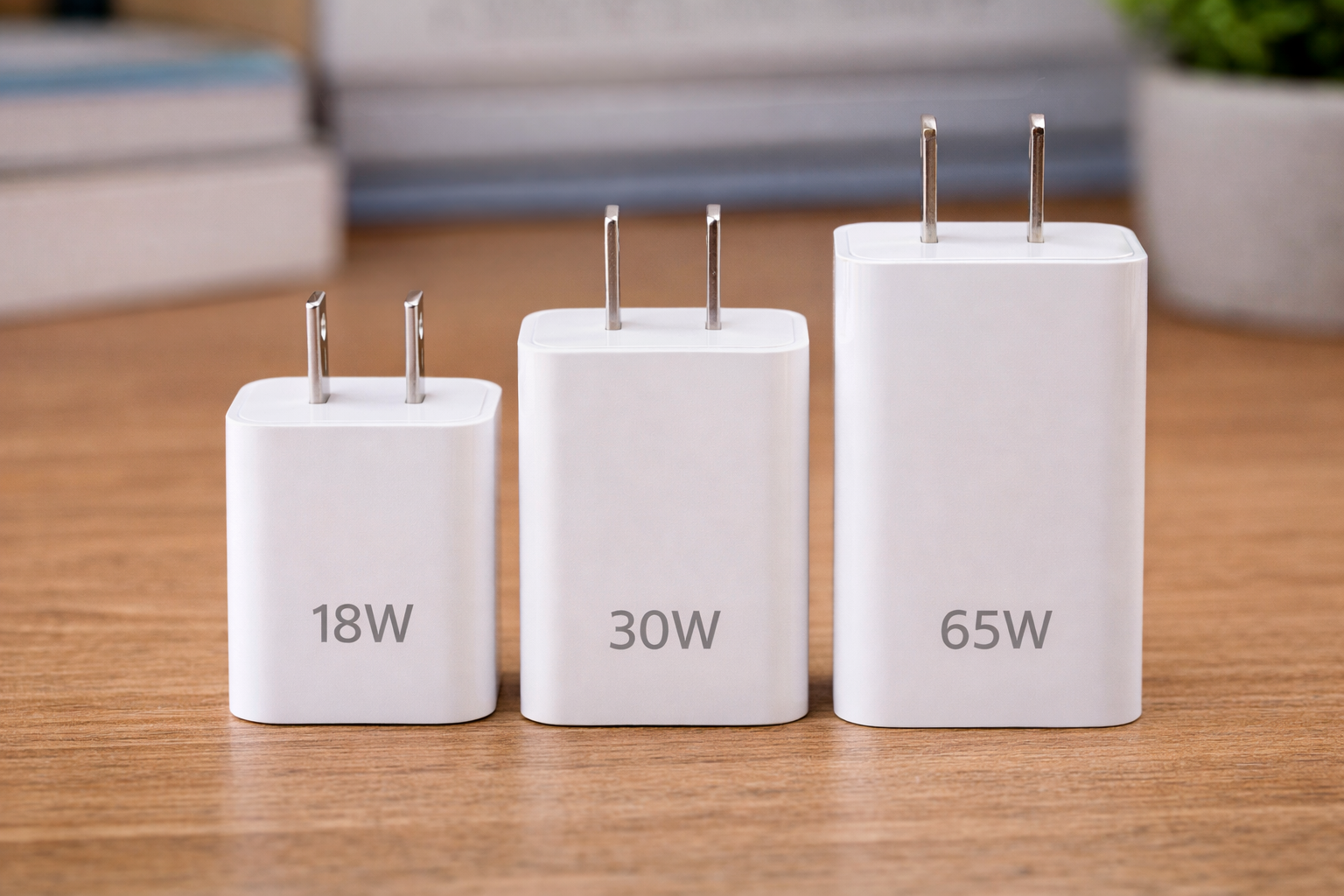
The wattage rating on a charger tells you its maximum power output. An 18W charger delivers up to 18 watts, a 30W charger up to 30 watts, and a 65W charger up to 65 watts. Higher wattage means faster charging — but only up to the limit your device supports. A phone that maxes out at 18W will charge at the same speed from an 18W charger as from a 65W charger.
Quick Answer
- 18W: Fast charging for most smartphones (iPhone, mid-range Android)
- 30W: Fast charging for tablets, flagship phones, and Nintendo Switch
- 65W: Required for laptops; overkill but harmless for phones and tablets
- Your device’s maximum input always caps the actual charging speed — a higher-wattage charger cannot force a device to charge faster than it’s designed to
How Wattage Determines Charging Speed
Watts = Volts × Amps. A standard 5W charger (5V/1A) takes 2–3 hours to charge a typical smartphone. Fast charging protocols raise voltage, current, or both:
- 18W: typically 9V at 2A
- 30W: typically 9V at 3A or 15V at 2A
- 65W: typically 20V at 3.25A
This is why a 65W charger can power a laptop — laptops require higher voltage (15–20V) that low-wattage chargers cannot provide. A 5W or 18W charger connected to a laptop either won’t charge it at all, or will charge it extremely slowly while the laptop is in use.
The charging curve matters
Fast charging isn’t linear. Most devices charge quickly from 0–60%, then deliberately slow down to protect the battery. This means the real-world advantage of higher wattage is most visible when your battery is depleted, not when topping off from 80%.
A phone connected to a 30W charger at 10% battery may draw the full 30W. The same phone at 70% may draw only 10–12W — meaning a 30W and an 18W charger produce identical speeds in the upper half of the charge cycle.
Device Compatibility by Wattage
18W charging
18W is sufficient for most smartphones. iPhones from the iPhone 8 through iPhone 14 support USB Power Delivery (PD) fast charging up to 18–20W. Plugging an iPhone into a 65W charger still delivers only 18–20W — the phone limits its own input.
Most mid-range Android phones also cap between 15W and 25W. For these devices, spending more on a 30W or 65W charger produces no speed improvement.
| Device | Max Accepted Wattage |
|---|---|
| iPhone 8–14 | ~18–20W |
| iPhone 15 | 20W |
| iPhone 15 Pro / 16 Pro Max | 27W |
| Samsung Galaxy S23 | 25W |
| Google Pixel 8 | 27W |
| iPad (10th gen) | 20W |
30W charging
30W unlocks faster charging on devices that support it — mainly tablets, select flagship phones, and gaming handhelds like the Nintendo Switch (which accepts up to 39W over USB-C PD).
For iPad Pro and iPad Air models, a 30W charger provides noticeably faster charging than an 18W unit because Apple’s tablets accept higher wattage inputs. A 20W charger on an iPad Pro charges slowly; 30W brings a meaningful speed improvement.
65W charging
65W is the minimum for practical laptop charging over USB-C. Most USB-C laptops require 45–65W to charge while in active use. Below that threshold, the laptop may charge only when the screen is off or in sleep mode.
| Device | Min. Recommended Wattage |
|---|---|
| MacBook Air (M-series) | 30W (light use) / 45W (sustained) |
| MacBook Pro 14” | 67W |
| Dell XPS 13 | 45W |
| Lenovo ThinkPad X1 | 65W |
| iPad Pro 12.9” | 30W |
For phones and tablets, a 65W charger is safe but provides no additional speed benefit over a correctly rated lower-wattage charger. The device’s internal charging controller caps the intake.
Charging Protocols: Why Wattage Alone Isn’t Enough
Wattage is the maximum — whether your device actually draws that power depends on protocol compatibility.
USB Power Delivery (PD) is the universal standard used by iPhones, iPads, MacBooks, many Android phones, and USB-C laptops. A USB-C PD charger rated at 65W will negotiate the correct voltage and current with any PD-compatible device.
Qualcomm Quick Charge (QC) is used by many Android phones (Snapdragon chipsets). A QC 3.0 charger and a USB-C PD charger may both be rated at 18W, but a QC phone may not fast-charge from a PD-only charger at full speed.
Programmable Power Supply (PPS) is an extension of PD 3.0 that allows finer voltage control. Some Samsung Galaxy phones achieve their maximum charging speed only with a PPS-compatible charger.
The practical rule: check which protocol your phone supports, then verify the charger supports the same protocol. Most modern USB-C chargers with PD support work across all major brands, but QC phones sometimes benefit from QC-specific chargers.
Cable Requirements
A 65W charger with a low-rated cable is a bottleneck. USB-C cables have different current ratings:
- Standard USB-C cables: rated for 3A (60W max at 20V)
- Full-featured USB-C cables (5A/100W rated): required for sustained charging above 60W
- USB-A to USB-C cables: capped at 18W regardless of charger output
If a 65W charger comes with a USB-A to USB-C cable, it cannot deliver 65W through that cable. A USB-C to USB-C cable rated for at least 3A (ideally labeled 60W or 100W) is required.
Common Mistakes
Assuming a higher-wattage charger is always better. For a phone that caps at 20W, an 18W charger and a 65W charger produce identical charging times. The 65W charger costs more and is physically larger for no benefit.
Ignoring the cable. A quality 30W charger with a cheap USB-A cable effectively becomes a 10–12W charger.
Expecting full speed at high battery levels. Fast charging slows significantly above 60–70% in almost all devices. Judging charging speed by plugging in at 80% will make all chargers appear equally slow.
Assuming 30W always beats 18W for phones. If the phone’s maximum input is 20W, a 30W charger provides no advantage over an 18W charger.
Frequently Asked Questions
Can a 65W charger damage a phone designed for 18W?
No. Devices contain charging controllers that limit how much power they draw. A phone rated for 18W will only pull 18W from a 65W charger — the extra capacity is simply unused.
Why does my laptop charge slowly from a USB-C power bank?
Most power banks output 18W or 30W. Laptops require 45–65W for normal operation while charging. Below that threshold, a laptop may charge only in sleep mode or discharge slowly despite being plugged in. I cover which power banks can charge laptops in a separate guide.
Does fast charging damage the battery long-term?
Modern devices manage heat and charge rate to minimize degradation. Fast charging does generate more heat than slow charging, and sustained heat is the primary cause of long-term battery capacity loss. Charging in a cool environment and avoiding charging to 100% repeatedly helps preserve battery health regardless of charger wattage.
What wattage do I need to charge an iPad Pro quickly?
iPad Pro models accept up to 30W over USB-C. An 18W charger works but is noticeably slower — Apple’s own tests show roughly 50% longer charge times compared to a 30W or higher charger.
Is 30W enough for a MacBook Air?
A 30W charger is sufficient for the MacBook Air during light tasks (web browsing, document editing). Under sustained CPU load, a 30W charger may not keep pace with power consumption. Apple recommends 35–45W for consistent charging under load.
Summary
18W handles fast charging for most smartphones. 30W adds meaningful speed for tablets and select flagship phones. 65W is the practical minimum for USB-C laptop charging. In all cases, a device’s maximum input wattage determines actual charging speed — the charger’s rating only sets the ceiling. Match the charger to the highest-demand device in your setup, and that same charger will work safely at lower wattage for everything else.
Need help choosing?
Take the quiz